Some cities are built from stone. Kashi builds soul into stone.
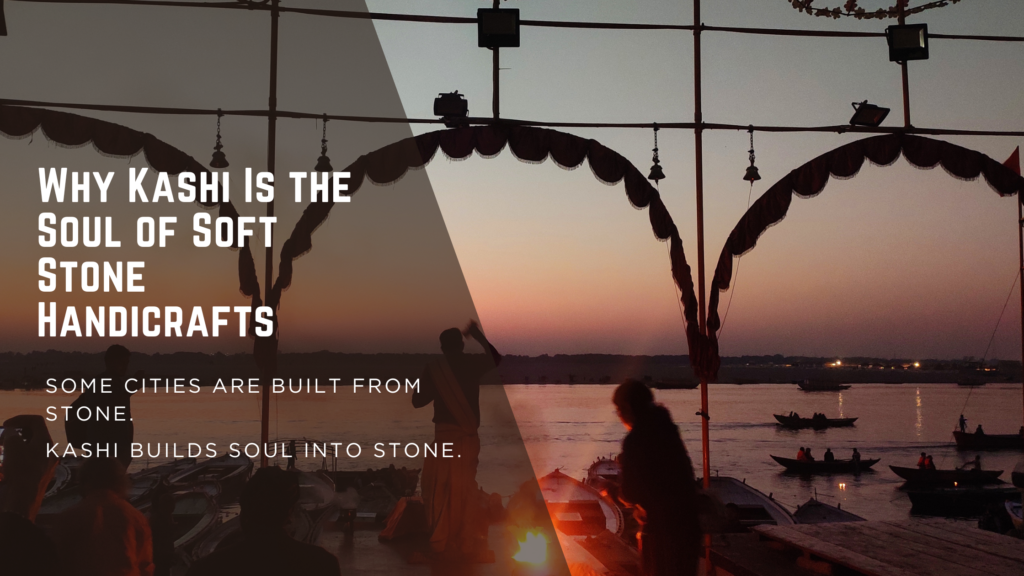
Where Stone Learns to Breathe
There is a city in India that is older than history itself. Mark Twain once wrote that Varanasi is older than tradition, older than legend — and looks twice as old as all of them put together. But what most visitors miss, walking past the ghats and the temple bells and the incense smoke, is what is happening in the quiet lanes just behind all that divinity.
In neighborhoods like Ramnagar, Luxa, and Vishwakarma Nagar, men sit cross-legged on stone floors. In their hands: a simple chisel. A small hammer. And a piece of soft, pale stone called gorara — soapstone — pulled from the earth of nearby Chunar. They tap. They pause. They study. They tap again.
What emerges from those hands is not just a product. It is a conversation between a human being and the earth itself.
This is Kashi soft stone handicraft — and no place on earth does it like Kashi does.
The Stone That Chose Kashi
Every great craft needs the right raw material, and Kashi was blessed by geography in ways that feel almost intentional. The Chunar and Mirzapur regions, just a short distance from Varanasi, hold some of India’s finest deposits of soft soapstone — locally called sajjar pathar or gorara.
Artisans prefer clean, evenly shaded stones for carving, ensuring that variations in pigmentation or veining do not disturb the quality of their work. Antima Khanna The stone is pale, cool, almost luminous — a blank canvas that holds whatever the artisan imagines.
What makes this stone extraordinary:
It is soft enough to be shaped with hand tools, yet strong enough to last centuries. It carries a natural coolness to the touch that no synthetic material can replicate. It is lightweight, making it ideal for both local display and international shipping. And in its raw form, it has a quiet, humble beauty — as if it is already waiting to become something sacred.
Artists originally carved on tusks and sandalwood, but as government regulations brought restrictions, they turned to the soapstone mines nearby — and the results were so successful that soapstone became the medium of choice. Antima Khanna What began as a necessity became a legacy.
Five Centuries of Tap, Tap, Tap
Close your eyes and imagine the sound of Kashi’s lanes in the 16th century. The Ganga flowing. Temple bells ringing. And underneath it all — the soft, rhythmic tapping of chisel on stone.
Varanasi has long been the seat of Aryan religion and philosophy, a center of arts, crafts, music, and dance — famous for its muslin, silk, ivory works, and sculpture. oriGIn Soft stone carving was never separate from this identity. It grew from it.
In early times, the artisans of Ramnagar received royal patronage from the royalties of Kashi themselves Authindia — the Maharajas who built the magnificent Ramnagar Fort understood that a city’s greatness is measured not just in its architecture, but in the hands of its craftspeople.
The Varanasi soft stone jali work can be seen on forts, zamindari homes, places of worship, and ancient monuments — all of which stand as testimony to its antiquity. IBEF
Five centuries later, the tapping continues. The craft did not die. It adapted, evolved, and endured — because in Kashi, nothing truly ends.
The Art That Defies Logic — The Undercut Miracle
If you want to understand why the world is fascinated by Kashi’s soft stone work, look at one product: the undercut elephant.
Inside a single, unbroken piece of soapstone, an artisan carves a full elephant — and inside that elephant, another smaller elephant — and inside that, another. Multiple figures, nested within each other, with no glue, no joints, no separate pieces.
Creating multiple shapes one inside another by carving stones — without any joints — is a unique craft of the Kashi artisans. Google Translate It is the kind of thing that, when you hold it in your hand, makes you question what is possible with patience and skill.
A skilled artist can complete an undercut elephant measuring two to three inches in just two hours. Antima Khanna Two hours for something that looks like it should take a lifetime to understand, let alone create.
This is the signature of Kashi — not just beauty, but impossible beauty.
The Jali — Where Stone Becomes Lace
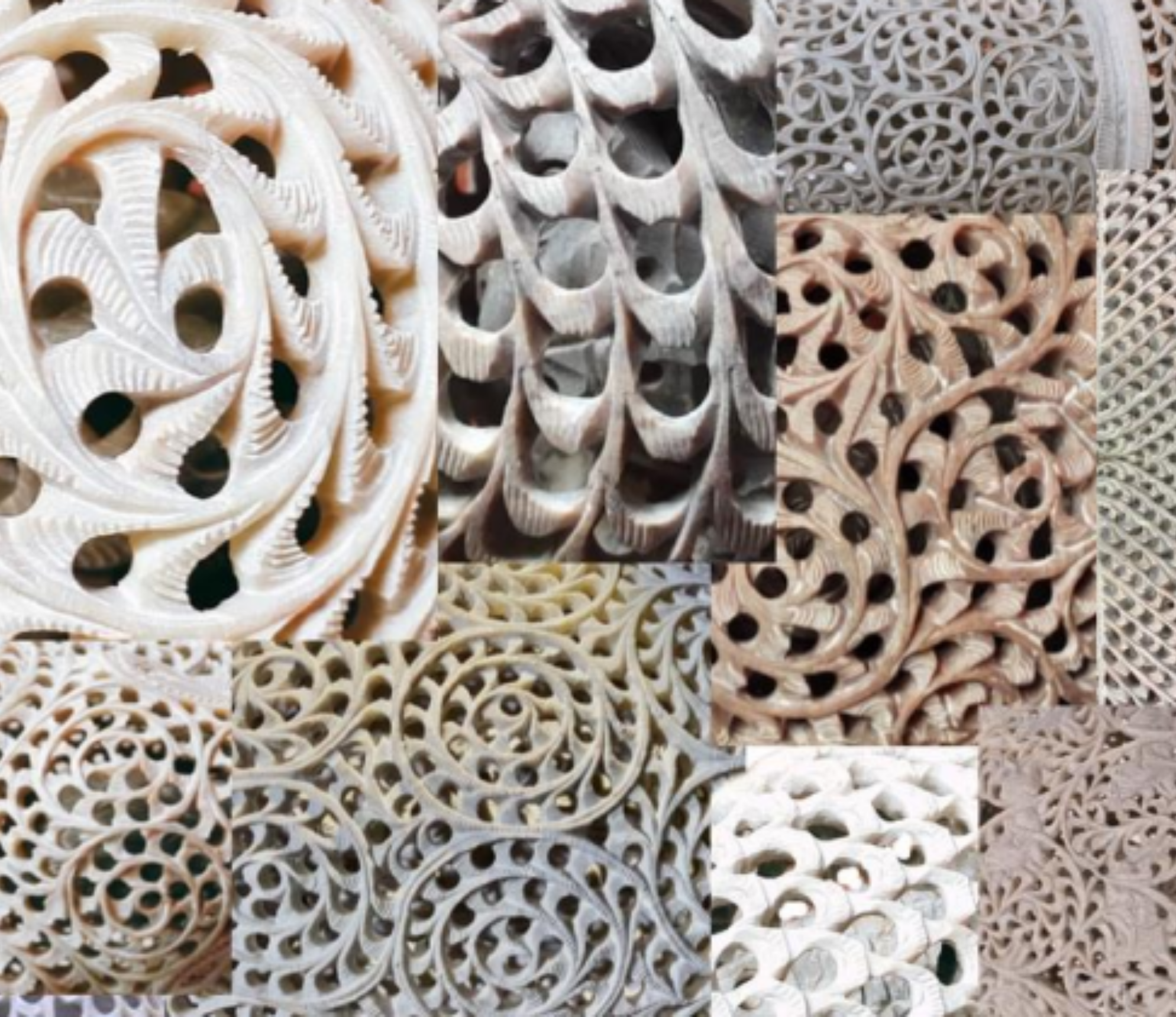
If the undercut elephant is Kashi’s miracle of depth, the jali (lattice fretwork) is its miracle of lightness.
Imagine stone that looks like lace. Panels so delicately pierced and patterned that light passes through them like it passes through a silk curtain. Geometric patterns so precise they seem mathematical. Floral motifs so fine they seem drawn, not carved.
Jali or fretwork is intricately carved on soft stone, and its process requires supreme mastery of masonry and design making — epitomizing both high skill and superior quality of craftsmanship. District Varanasi
This is not decoration. This is devotion made physical. Every jali panel represents hundreds of calculated chisel strikes, each one placed with the confidence that comes only from a lifetime of practice. One wrong strike — and the piece is lost. There is no undo button in stone.
The Artisans — Men Who Speak in Stone
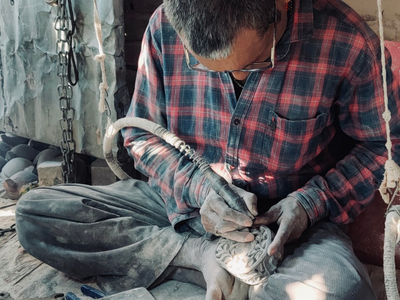
Behind every breathtaking piece is a man whose name the world will never know.
He woke up before sunrise. He sat in the same corner of the same small workshop where his father sat, and his grandfather before that. His tools are simple — a chisel, a hammer, sandpaper, and water sprinkled occasionally to keep the stone cool. The craftsman first studies the natural design contained in the stone itself, then shapes it carefully with chisel and hammers, sprinkling water repeatedly to avoid heat generation. oriGIn
He does not sketch elaborate blueprints. The design lives in his hands, inherited through muscle memory across generations.
Today, around 500 to 700 artisans are engaged in this traditional craft Google Translate — a living community that has survived Mughal transitions, colonial neglect, market floods of cheap Chinese imports, and power cuts that disrupted production for years. They survived because this craft is not just their profession. It is their identity.
State awardee Dwarika Prasad of Ramnagar once said: “There was a time when artisans were leaving this work due to lack of electricity and market. But we stayed. This is not just a job for us. This is who we are.”
GI Tagged — The World’s Official Stamp of Authenticity
In 2018, the world officially recognized what Kashi had known for centuries.
Varanasi Soft Stone Jali Work received its GI (Geographical Indication) Tag certification on 28th March 2018 District Varanasi — placing it in the same elite category as Darjeeling tea, Banarasi silk, and Alphonso mangoes. This tag means one thing above everything else: you cannot call it Varanasi soft stone unless it was made in Varanasi, by Varanasi hands.
It is the world’s promise to the artisan that his work will not be stolen, imitated, or devalued without consequence.
The craze for this craft has grown steadily in the markets of Europe, Gulf countries, Buddhist nations, and America. Authindia A piece carved in a quiet lane in Ramnagar now sits in homes in Paris, Dubai, and New York — carrying Kashi’s soul across the globe.
How to Recognize Authentic Kashi Soft Stone
In a market flooded with machine-made imitations, knowing the real thing matters — for your purchase, and for the artisan whose livelihood depends on it.
Touch it. Genuine Kashi soapstone feels cool, smooth, and slightly silky — never rough or plastic-like. Weigh it. It should be lighter than it looks. If it feels heavy like marble, it probably is marble. Look at the edges. Hand-carved pieces carry subtle, organic irregularities. Machine-made pieces are too perfect — and perfection, in this case, is a red flag. Ask for the GI certification. A responsible seller will always have it. Trust the price. A piece that took a master artisan three days to carve cannot honestly cost less than a meal. Deeply discounted “Varanasi handicrafts” are almost always not from Varanasi at all.
More Than a Purchase — A Piece of Living History
When you bring home a piece of Kashi soft stone, you are not buying décor. You are not simply adding something beautiful to a shelf or a prayer corner.
You are holding five centuries of human persistence in your hands. You are supporting a family in Ramnagar whose grandfather carved for a Maharaja. You are keeping alive a sound — that quiet, rhythmic tapping — that has been the heartbeat of Kashi’s lanes for generations.
Banaras is older than history, older than tradition, older than legend — and it looks twice as old as all of them put together. oriGIn And soft stone handicrafts are how that ancient city reaches into your home and stays there.
Kashi Does Not Just Make Things — It Makes Meaning
Other cities manufacture. Kashi consecrates.
There is something in the air of Varanasi — the prayers, the incense, the Ganga, the five centuries of devoted hands — that enters the stone itself. A soapstone elephant from Ramnagar is not the same as a soapstone elephant from a factory in China. One is a product. The other is a story.
A story of a city that chose to be eternal. A story of craftsmen who chose stone over surrender. A story of an art form that refused to be replaced by machines, by imports, by time.
That is why Kashi is not just a location for soft stone handicrafts.