Blog

Your blog category

Blog

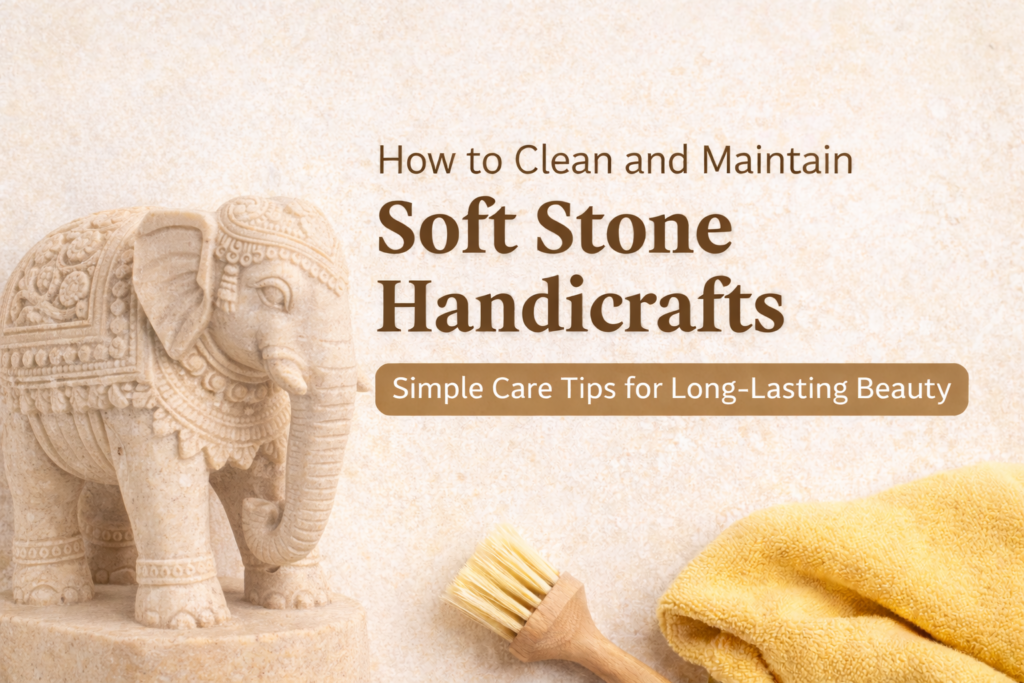
How to Clean and Maintain Soft Stone Handicrafts at Home

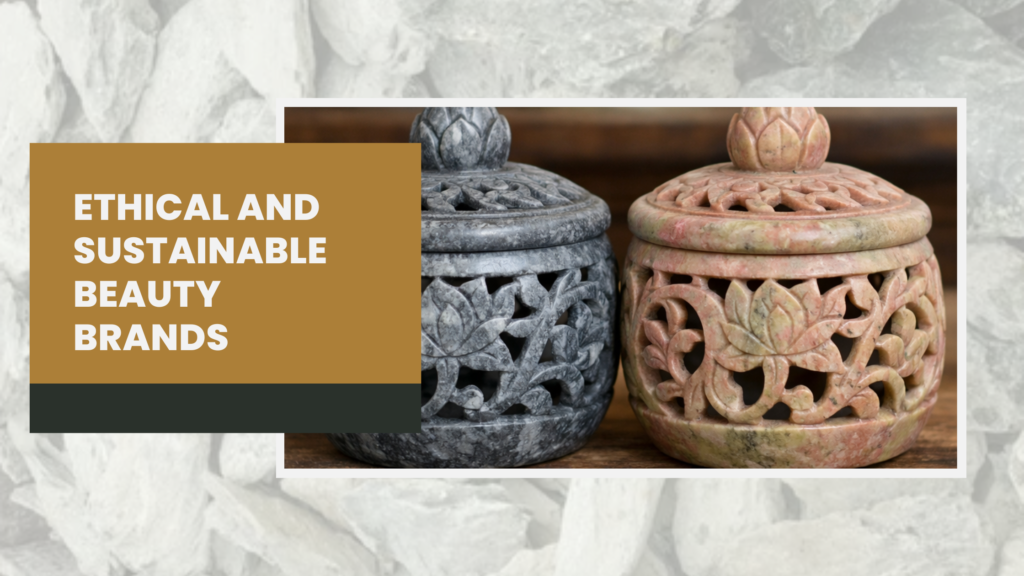
A Complete Care Guide for Stone Decor Owners | Home & Lifestyle Introduction You spent good money on that beautiful soapstone idol, marble showpiece, or onyx decorative bowl — and naturally, you want it to stay as stunning as the day you brought it home. But here’s the thing: soft stone handicrafts are not like regular home decor. They are porous, delicate, and surprisingly sensitive to everyday household products that seem completely harmless. Whether you own a Agra marble elephant, a Rajasthani soapstone vase, a carved limestone figurine, or a green onyx tray from Udaipur — this guide is written specifically for you. We will cover the right way to clean, what chemicals to never use, how to bring back lost shine, and how to maintain your stone decor for years to come — all using simple things available at home. What Are Soft Stone Handicrafts? (Know Your Stone First) Before cleaning anything, you need to know what type of stone you are working with. Different stones have different tolerances. Common soft stones used in Indian handicrafts: Soapstone (Gorara / Steatite) — Used in Agra, Rajasthan, and Odisha for idols, incense holders, and decorative carvings. Very soft (Mohs hardness 1–2), easily scratched, and quite porous. Marble — Used across Rajasthan for figurines, trays, and wall art. Moderately soft and highly sensitive to acidic substances. Agra white marble and pink Rajnagar marble are most common in Indian handicrafts. Onyx — Used for lamps, bowls, and decorative panels. Very porous and sensitive to moisture, heat, and acids. Requires the most careful handling. Limestone / Sandstone — Used in carved wall panels and religious art. Porous and dusty by nature. Alabaster — Used in translucent decorative pieces. Extremely soft and water-sensitive — never submerge in water. Once you know your stone, cleaning becomes much safer and more effective. Section 1: Daily & Weekly Dusting — The First Line of Defence Most people skip this step, but it is actually the most important part of stone care. Dust particles, when left on a stone surface, act like micro-sandpaper. Over time, they scratch and dull the polish of even the hardest stones — and for soft stone handicrafts, the damage happens much faster. How to dust soft stone handicrafts correctly: Use a dry, soft microfiber cloth. Wipe gently in one direction — not in circles. A soft-bristle paintbrush (like a wide watercolour brush) works brilliantly for getting into carved grooves, jaali work, and intricate designs without scratching the stone. Never use a regular household duster with stiff bristles or feathers. These can leave hairline scratches on polished soapstone and marble surfaces that are difficult to reverse. Frequency: Dust your stone handicrafts at least once a week. If you live in a dusty area (which most Indian homes do, especially during summer), do it twice a week. Pro tip: Keep stone pieces slightly away from open windows where dust and grit flow in directly. A glass shelf or display cabinet reduces dusting frequency significantly and protects the surface from accidental contact. Section 2: How to Clean Soft Stone Handicrafts at Home — Step by Step When dusting is not enough — after a spill, during seasonal cleaning, or when the piece looks dull — here is the correct cleaning method. What you will need: Step 1 — Remove loose dust first Before any water touches the stone, dust it completely with a dry microfiber cloth. Wet dust is harder to remove and can get pushed into pores. Step 2 — Prepare your cleaning solution Mix lukewarm water with just 1–2 drops of mild dish soap. The water should be barely soapy — not bubbly. Too much soap leaves a film on the stone that attracts more dust later. Step 3 — Damp wipe, never soak Dip your microfiber cloth in the solution and wring it out until it is only slightly damp — not wet. Wipe the stone surface gently. Never pour water directly onto soft stone handicrafts. Never submerge them in water. Alabaster and soft soapstone pieces can absorb moisture and weaken structurally if soaked. Step 4 — Clean carved grooves carefully Use a soft toothbrush dipped in the same mild solution to gently work through intricate carvings, jaali patterns, or raised motifs. Work in gentle circular motions. Rinse the brush often. Step 5 — Rinse with a plain damp cloth Take a second cloth dampened with plain water (no soap) and wipe the surface again to remove any soap residue. Soap film left behind will cause streaks and attract dust. Step 6 — Dry immediately and completely This step is critical. Use a dry soft cloth to remove all moisture from the surface. Do not leave soft stone pieces air-drying while wet — moisture seeping into pores can cause staining, discolouration, and in worst cases, cracking over time. Section 3: Removing Common Stains from Stone Decor Oil-Based Stains (Ghee, cooking oil, hand cream, cosmetics) Oil stains darken the stone and can be stubborn if left for long. As soon as you notice one, blot — never wipe — with a dry paper towel to absorb excess oil. Then apply a small amount of mild dish soap directly to the spot, leave for 2 minutes, and wipe with a damp cloth. For older oil stains, make a paste of baking soda and water, apply it to the stain, cover with plastic wrap, and leave for 24 hours. Wipe clean and rinse. Organic Stains (Chai, coffee, haldi, fruit juice) These leave pinkish-brown marks on light-coloured stones. For fresh stains, flush immediately with plain water and dry thoroughly. For set stains on light-coloured stones like white marble or alabaster, apply a few drops of 3% hydrogen peroxide (available at pharmacies) directly on the stain, leave for 10 minutes, then wipe clean. Do not use hydrogen peroxide on dark or coloured stones as it can bleach them. Water Spots and Mineral Deposits If your stone piece sits near a water source or plant pot, white chalky deposits
Blog

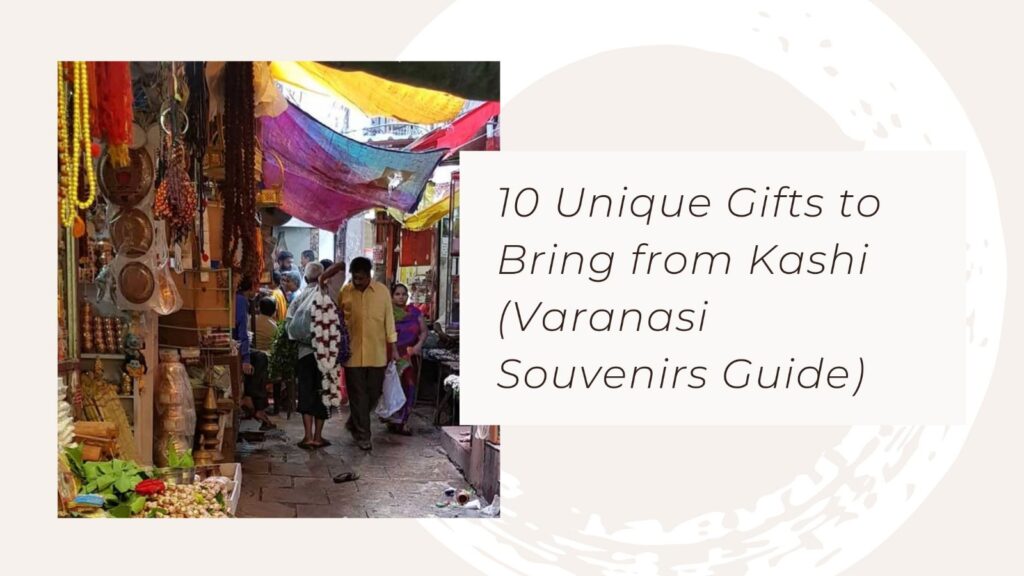
10 Unique Gifts to Bring from Kashi (Varanasi Souvenirs Guide)

Every city sells souvenirs. Kashi sells pieces of itself. Why Kashi’s Gifts Are Different Most souvenirs tell you where you have been. A fridge magnet. A keychain. A printed mug. You put them on a shelf and forget them. Kashi’s gifts are different. They do not sit quietly on shelves — they carry energy. The weight of a brass lamp from Thatheri Bazaar feels different in your hands than any other lamp. A Banarasi silk saree does not just drape — it declares. A soft stone idol from Ramnagar does not just decorate — it holds the prayers of the artisan who made it, the dust of Chunar’s mines, and five centuries of unbroken craft tradition. Shopping in Varanasi beats hands down many other cities of India. One reason is its long 5,000 years of history — people of many walks of life, over centuries, came and settled here, contributing to a multi-art and craft culture that has created several famous things to buy. Handicrafts This guide covers the 10 most meaningful, most beautiful, and most genuinely Banarasi gifts you can bring home — and exactly where to find them. 1. Soft Stone Handicrafts — Kashi’s Most Unique Gift What it is: Hand-carved sculptures, idols, jali panels, diyas, and decorative pieces made from gorara — soapstone sourced from Chunar and Mirzapur near Varanasi. Why it is special: Of all the things you can bring home from Kashi, soft stone handicrafts are the most irreplaceable. Varanasi is famous for its stone carving tradition which flourished during the reign of King Ashoka — and the stones for the Pillars of Ashoka themselves came from the Chunar region of the city. D’source This craft is therefore not a market product. It is living archaeology. No two pieces of gorara are ever identical. The color, the grain, the natural markings — all change from block to block, making every piece genuinely one of a kind. Furthermore, the signature techniques of Kashi’s stone carvers — the undercut elephant with nested figures carved from one unbroken stone, and the jali fretwork so delicate that light passes through it like silk — exist nowhere else on earth. Varanasi Soft Stone Jali Work holds an official GI Tag since 28th March 2018 — meaning a certified piece can only come from Varanasi artisan hands. Best for gifting to: Home décor lovers, spiritual gifting, collectors, international visitors who want something genuinely made in India. Where to buy: Ramnagar, Vishwakarma Nagar, shops near Assi Ghat. Always ask for GI certification. Explore our complete soft stone collection for authenticated pieces directly from Varanasi artisans. Price range: ₹200 for small pieces to ₹5,000+ for detailed undercut or jali work. 2. Rudraksha Mala — Kashi’s Sacred Blessing What it is: Sacred prayer beads made from the seeds of the Rudraksha tree — worn by Shiva devotees and spiritual seekers across India and the world. Why it is special: The Rudraksha is the textured seed of the Rudraksha tree — Rudraksha literally means the tear of Rudra, an earlier form of Shiva. It is the most popular organic jewelry that saints have worn from time immemorial. Antima Khanna The Rudraksha tree does not sprout anywhere in Varanasi — but it is a perfect place to buy a Rudraksha mala. You can find any type of Rudraksha here, even the rare ones. Buying a Rudraksha in Kashi — the city of Shiva — carries a spiritual significance that buying the same bead anywhere else simply does not. Best for gifting to: Spiritual seekers, Shiva devotees, yoga practitioners, anyone going through a period of transition or seeking grounding. Where to buy: Vishwanath Gali and Dashashwamedh Market — numerous certified sellers. Price range: ₹100 for basic malas to ₹10,000+ for rare multi-faced Rudrakshas. 3. Brass and Brassware — The Metal That Carries Prayer What it is: Hand-crafted brass lamps, diyas, puja thalis, water pots, and decorative items — engraved with traditional motifs, deities, and geometric patterns. Why it is special: From ornate lamps to decorative plates, the brass items crafted in Varanasi are not just beautiful but also functional — each piece tells a story of the artisan’s skill and tradition. D’source Varanasi’s brass tradition is as old as its temple culture — the two grew together, each feeding the other. The Thatheri community of Varanasi — brassware craftsmen whose technique was inscribed on UNESCO’s Intangible Cultural Heritage list — hammer and chisel their designs by hand. The sound of their work echoes through Thatheri Bazaar the same way it has for centuries. Best for gifting to: Home décor enthusiasts, those with a home temple, anyone who appreciates functional craft. Where to buy: Thatheri Bazaar — the dedicated brass market of Varanasi. Price range: ₹150 for small diyas to ₹3,000+ for large engraved lamps. 4. Wooden Lacquerware Toys — Color and Childhood in One Gift What it is: Hand-turned wooden toys — birds, animals, human figurines, and nested boxes — painted in bright lacquer colors by craftsmen in the Khojwa area of Varanasi. Why it is special: You can find wooden toy makers in lanes of Varanasi — Khojwa is one such area where wood crafters make sets of birds and animals in bright colors. Among the most unique pieces is a Russian-doll recreation of the Shiva family — a box in the form of Shiva, and when you open it, out comes Parvati, then Kartik, and finally Ganesha. Antima Khanna This is the gift that makes children’s eyes widen and adults go quiet with something like nostalgia. Simple, beautiful, completely handmade — and carrying the specific energy of Kashi’s craft lanes. Best for gifting to: Children, families, anyone who loves folk art and handmade toys. Where to buy: Sharma Toys Emporium near Dashashwamedh Ghat for wide variety and reasonable rates. D’source Also available at Varanasi airport for last-minute gifting. Price range: ₹50 for small pieces to ₹500+ for detailed nested sets. 5. Sphatik (Crystal) Shivalinga — A Blessing You Can Hold What it is: A

Blog

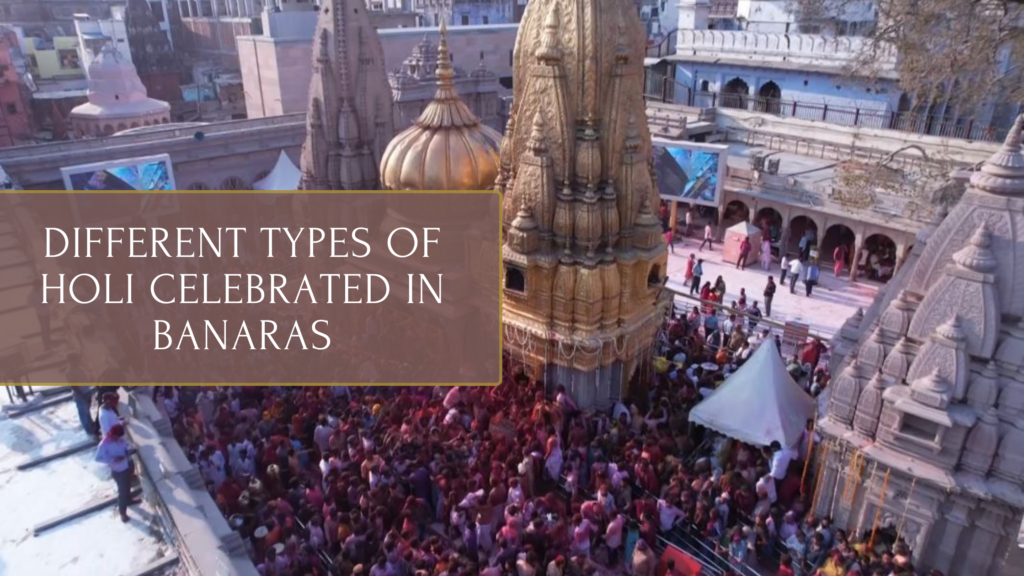
Different Types of Holi Celebrated in Banaras

Every city plays Holi with colors. Banaras plays Holi with its soul. Where Holi Is Not Just a Festival — It Is a Philosophy Most cities in India celebrate Holi for one day. Banaras celebrates it for six. Most cities play Holi with gulal and water. Banaras plays Holi with flowers, with pyre ash, with processions that began at a Maharaja’s doorstep, and with chants that shake the stones of temples older than recorded history. In Banaras, Holi is not a single event. It is a journey — from the divine union of Shiva and Parvati all the way to the cremation grounds of Manikarnika, from the color-drenched lanes of the old city to the peaceful ghats where the Ganga flows as if it has seen all of this before, a thousand times, and loves it every time. Varanasi Holi festival includes the standard Holi, Masan ki Holi, and Rangbhari Ekadashi — each distinct from the other, each carrying its own spiritual weight and cultural character. KRAFTERIA This guide takes you through every type of Holi that Banaras celebrates — what it means, where it happens, and why no other city in the world does Holi quite like this. Type 1 — Rangbhari Ekadashi: The Holi That Begins With a Divine Wedding When: Five days before main Holi — Phalguna Shukla Ekadashi Where: Kashi Vishwanath Temple, Vishwanath Gali, Tedhi Neem If you want to understand why Banaras celebrates Holi the way it does, you must first understand Rangbhari Ekadashi — because this is where it all begins. According to tradition, Lord Shiva got married to Goddess Parvati on Mahashivratri. Two weeks later, on Rangbhari Ekadashi, Mahadev brought her to his city Kashi for the first time after his marriage. Rangbhari Ekadashi is celebrated to commemorate the reunion of Shiv and Shakti. IBEF On this sacred occasion, Kashi Vishwanath is adorned with special decorations, and the city begins to immerse itself in the vibrant colors of Holi. A grand procession of Lord Shiva is carried out through the streets, where devotees joyfully throw abir and gulal. Antima Khanna The procession starts from the Mahant’s house in Tedhi Neem and ends at the Kashi Vishwanath temple. The narrow lanes of Vishwanath Gali are packed like sardines with people and colors as the procession moves along. IBEF The festival begins with the playing of gulal with Lord Shiva and Mata Gauri, symbolizing the blessing of a happy married life. Kashi Vishwanath and Mata Gauri are dressed up for the occasion, and the festival is marked with dancing and music, bringing the streets of Kashi to life. oriGIn This is the only Ekadashi in the Hindu calendar dedicated to Lord Shiva — all others belong to Lord Vishnu. While Ekadashi is usually associated with Lord Vishnu, Rangbhari Ekadashi uniquely holds special significance for Lord Shiva devotees, connected to the joyful legend of Lord Shiva and Goddess Parvati returning to Kashi after their wedding. Directcreate Rangbhari Ekadashi is therefore not a pre-Holi event. It is Holi itself — just celebrated six days early, in the most Banarasi way possible: through devotion, procession, and pure divine joy. Type 2 — Masan Ki Holi (Bhasma Holi): Holi at the Cremation Ground When: The day after Rangbhari Ekadashi Where: Manikarnika Ghat and Harishchandra Ghat If Rangbhari Ekadashi is Holi at its most joyful, Masan Ki Holi is Holi at its most profound. Masan Ki Holi is a ritual observed at Manikarnika Ghat — one of the oldest and continuously active cremation grounds in India. During this ritual, sadhus and devotees apply ash instead of colors, symbolizing detachment from material life and acceptance of mortality. The ritual is associated with Lord Shiva. D’source In Varanasi, Holi is not played with colors and gulal but with the ashes of pyres. This Holi of Kashi is known as Masan ki Holi. ‘Masan ki Holi’ begins after the aarti of Mahashmashan Nath at Harishchandra Ghat in Banaras. On the day of Masan Holi, saints and Shiva devotees play Holi with the ashes of pyres after worshiping Lord Shiva. During this, Manikarnika Ghat resounds with the chants of ‘Har-Har Mahadev.’ District Varanasi The mythology behind it is as powerful as the ritual itself. A day after Rangbhari Ekadashi, Shiva visits Masan to celebrate the same Holi with his Ganas, ghosts, and spirits that live at the cremation ground. The juxtaposition of these two events symbolizes how contradictory life can be — one reflects the engagement of Shiv with the world and its Moh Maya, while the other is completely dedicated to the Shiv who is a destroyer and ruler of shamshan, sanyas, and renunciation from the world. As per the traditions, locals, Naga Sadhus and Aghoris flock to Manikarnika Ghat to play Holi with ashes of burning pyres. The festival starts with a grand aarti at the Masaan temple located near Manikarnika Ghat. Devotees smear the Shivling with ashes surrounded by the roaring sound of damru. The contrast between Masaan Holi and Rangbhari Ekadashi is deeply symbolic. One represents detachment and acceptance of life’s ultimate truth, while the other represents joy, love, and celebration. The sequence of Masaan Holi followed by Rangbhari Ekadashi reflects a powerful spiritual teaching: before celebrating life, one must understand death. Before embracing joy, one must accept impermanence. This philosophy is unique to Kashi. Masan Ki Holi is not for everyone. It is, however, an experience that changes everyone who witnesses it. Type 3 — Lathmar Holi: When Women Rule the Festival When: A few days before main Holi Where: Assi Ghat and nearby temples Inspired by the legendary Lathmar Holi of Barsana — where Radha’s village women playfully beat Krishna’s companions with sticks — Banaras has adopted and joyfully made this tradition its own. Inspired by the well-known Barsana Holi in Uttar Pradesh, the Lathmar Holi is one of the most spectacular Banaras Holi customs. This distinctive custom is observed in Varanasi near the Assi Ghat and other temples, where women playfully chase men with sticks as

Blog

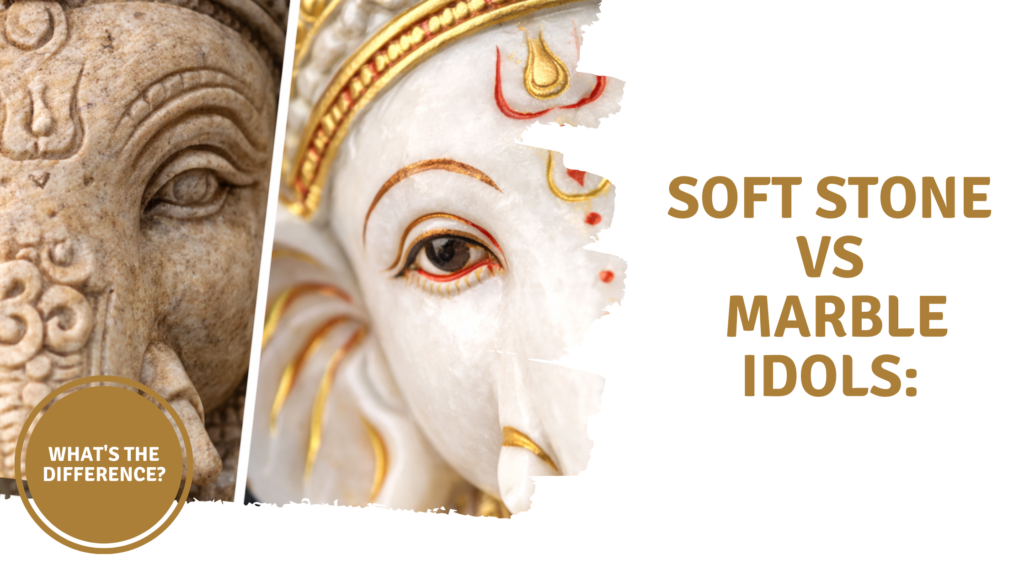
Soft Stone vs Marble Idols: What’s the Difference?

Two stones. Two traditions. Two completely different conversations with the divine. The Question Every Buyer Eventually Asks You are standing in front of two beautiful idols. Both are stone. Both are hand-carved. Both carry the same deity, the same posture, the same devotion in the hands that made them. One is marble. One is Kashi soft stone — gorara. They look similar at a glance. But the moment you pick them up, something shifts. The weight is different. The texture is different. The feeling in your hand is different. And if you know what you are looking for, the story behind each one is completely different too. This guide exists to help you understand that difference — not just technically, but in every way that matters when you are choosing an idol for your home, your pooja space, or as a gift to someone you love. And by the end, you will know exactly which one belongs in your life. Browse our complete soft stone idol collection to see Kashi’s craft up close. First — What Are These Two Stones, Actually? Before comparing the idols, it helps to understand the materials themselves. Soft stone — called gorara or sajjar pathar in Varanasi — is a metamorphic rock whose scientific name is pyrophyllite. Soapstone, or steatite, is soft enough to carve with a knife. It is composed of talc and has a slippery, soapy feel. District Varanasi On the Mohs hardness scale — where diamond sits at 10 — soapstone typically ranges from 1 to 5, while marble ranges from 3 to 5. oriGIn Furthermore, artistic soapstone, which is what sculptors use, can have talc content as high as 80%, making it about as silky and soft as real soap — which makes it very easy to carve. Google Translate Marble, on the other hand, is limestone that underwent extreme heat and pressure inside the earth. Polished marble is smooth and silky with a highly reflective surface — you can often see your face reflected in it. Marble is at least two colors or tones and has a distinct pattern. D’source Although marble is durable, it is also soft enough to carve detailed designs — this balance makes it perfect for creating intricate idols and sculptures. Antima Khanna In other words, both are beautiful. Both are carvable. But they come from different geological journeys — and they produce very different results in an artisan’s hands. For a deeper understanding of soft stone specifically, read our complete guide: What Is Soft Stone? Why Is It Used in Varanasi Handicrafts? Difference 1 — Hardness and Carving Detail This is where the two materials diverge most dramatically — and where Kashi’s soft stone tradition earns its reputation. Soapstone allows for intricate carvings and ages beautifully over time, while marble is favored for its smooth texture and elegance, making it ideal for refined, freestanding idols. D’source Because gorara is so much softer, Varanasi artisans can cut inward, around corners, and behind surfaces in ways that marble simply does not allow. This is why the undercut technique — where multiple figures sit nested inside each other from a single unbroken piece of stone — exists only in Kashi’s soft stone tradition. Attempting it in marble would shatter the piece. Marble, conversely, holds its surface detail with greater permanence. A sharp line carved into marble stays sharp for decades. Marble consequently works beautifully for large, bold idol forms where presence and polish matter more than intricate interior carving. The honest comparison: soft stone wins on fineness of surface detail and depth of carved work. Marble wins on bold, high-polish visual impact from a distance. Difference 2 — Weight and Practical Use Pick up a soft stone idol. Then pick up a marble idol of the same size. The difference is immediate and surprising. When held to the light, soapstone has a smooth, greasy, silky, milky luster. If thin, it is translucent. It is cold to the touch. D’source But beyond feel, it is meaningfully lighter. This weight difference matters in several practical ways. For pooja and daily use, a lighter idol is easier to move, clean, and arrange. For gifting, soft stone pieces can be shipped internationally at far lower freight costs — which is one reason Kashi’s handicrafts reach Paris, Dubai, and New York from a workshop in Ramnagar. For home display, lighter pieces work on shelves, mantelpieces, and altars without structural concern. Marble idols, meanwhile, carry a sense of permanence and weight that many devotees specifically seek. A large marble murti in a home temple feels anchored — like it belongs there and will never move. Makrana marble is so durable that it lasts for generations without losing its shine, is easy to clean, and looks beautiful in any home or temple. Antima Khanna The honest comparison: soft stone for lightweight versatility and travel. Marble for large, permanent, temple-grade presence. Difference 3 — Color, Texture, and Uniqueness This difference is perhaps the most poetic — and the most important for buyers who value authenticity. Marble is celebrated for its classic look. Makrana white marble — the same stone used in the Taj Mahal — is famous for its luminous, pure white surface and elegant veining. It is consistent, predictable, and unmistakably grand. Soft stone is the opposite of predictable. The talc in soapstone gives it unique milky, muted colors that add a vintage or rustic look. The most common colors of soapstone range between white and gray — some slabs will darken or develop slight greenish tones over time. oriGIn Varanasi’s gorara, furthermore, extends this range dramatically — from creamy white and pale gray to bright pink, deep green, and even black, depending on the specific block. Moreover, no two pieces of gorara are ever alike — not even from the same block. Every genuine Kashi soft stone idol is therefore completely unique in the world. It is mathematically impossible for your piece to be identical to anyone else’s. Marble, by contrast, can be

Blog

What Is Soft Stone? Why Is It Used in Varanasi Handicrafts?

Before an artisan picks up his chisel, the stone has already lived a million years. Understanding what it is makes you understand why it matters. A Stone Unlike Any Other Most people who hold a piece of Varanasi soft stone for the first time say the same thing: it feels warm. Not temperature-warm — emotionally warm. There is something about its surface, its weight, its quiet luminosity that feels less like holding a rock and more like holding something that was once alive. That feeling is not a coincidence. It comes directly from what soft stone actually is — and from the extraordinary journey it took, across millions of years and thousands of miles beneath the earth, to arrive in an artisan’s hands in the lanes of Ramnagar, Varanasi. This is the story of soft stone — the heart of Varanasi’s most celebrated handicraft tradition. What Is Soft Stone, Scientifically? Soft stone — known locally in Varanasi as gorara or sajjar pathar — is a metamorphic rock whose scientific name is pyrophyllite. It belongs to the same broad mineral family as talc, which is why it registers at the very bottom of the Mohs hardness scale — between 1 and 2 — making it one of the softest natural stones on earth. While marble is the hardest form of limestone, soapstone is the softest and is easy to work on. For this specific property, any kind of carving can be done by hand on soft stone. oriGIn Artistic soapstone is made up of 80% talc. It is so soft that it can be scratched with a fingernail. D’source This extreme softness is not a weakness — it is precisely the quality that makes it the perfect canvas for the kind of impossibly detailed hand carving that Varanasi is famous for. Soapstone is relatively soft because of its high proportion of talc. Softer grades may feel similar to soap when touched, hence the name. Soapstone is easy to carve — it is also durable and heat-resistant and has a high heat storage capacity. D’source For a deeper understanding of how this stone becomes finished art, read our detailed guide on the complete soft stone carving process in Varanasi. Where Does Varanasi’s Soft Stone Come From? Geography gave Varanasi a gift that no other city in India quite received. Stones are brought from mines of Chunar and Shivpuri in Madhya Pradesh. The most appreciated quality of this stone is that it is available in a wide range of colors and is easy to carve. KRAFTERIA The stone work of Varanasi is very different from other places. Instead of hard marble, carving is done on a soft stone called gorara — a stone brought from the Hamirpur and Mahoba areas. The uniqueness of gorara is its unpredictable range of colors. On polishing, mottled gorara brings out a hue of shades varying from gray to bright pink, green to black. Handicrafts Gorara stone is easy to carve, durable, and popular for its heat-resistant properties. One of the distinctive properties of gorara stone is its unpredictable color spectrum, which may vary from beautiful shades of gray to bright pink. This color unpredictability is not a problem to be solved — it is the magic of the material. Every block that arrives in a Varanasi workshop is a surprise. Every finished piece is therefore, by definition, one of a kind. The Most Important Fact About Soft Stone Here is the fact about soft stone that separates it from every other carving material in the world — and the fact that every buyer should understand before purchasing: There is no homogeneity of colour, tint and texture in soft stone. Two pieces taken out even from the same block of soft stone are never alike. Thus, it is virtually impossible to get two carved pieces of soft stone of identical colour or design. You may say soft stone is blessed by nature. They are like free hand sketches by a small child. oriGIn Read that again: no two pieces are ever alike. Not from different blocks, not even from the same block. Every single piece of genuine Kashi soft stone is therefore, mathematically and naturally, unique in the entire universe. This is why machine production cannot replicate what Varanasi artisans do. A machine can be programmed for one stone — but the next stone will be different. And the one after that. The hand of the artisan is the only instrument sensitive enough to respond to each stone individually, in real time, with each chisel strike. Why Soft Stone — Not Marble, Not Granite? This is the question at the heart of Varanasi’s craft identity. India has marble. It has granite. It has sandstone. So why did Varanasi’s artisans choose soft stone — and why do they continue to choose it today? The answer has several layers. Starting with history — in the early stages of stone carving, artists used tusks and sandalwood as their primary medium. However, due to government regulations and constraints, they had to seek alternatives. The nearby soapstone mines became the experimental ground for these artists, where they replicated their designs previously carved on tusks. What began as necessity quickly became preference — and then mastery. Because soft stone, it turned out, could do things that no other material could. Consider what makes it uniquely suited to Varanasi’s craft tradition specifically: It responds to simple hand tools. The undercut carving technique — where figures sit nested inside each other with no joints — is physically impossible in marble. The material is too hard, too unforgiving. In gorara, a skilled artisan can carve inward, around, and behind without the piece shattering. Furthermore, it is lightweight. This matters enormously for both the artisan — who works with it for hours daily — and for the buyer, who can ship it internationally without freight costs making it unaffordable. Additionally, it accepts color beautifully. Because the surface is so smooth and fine-grained after polishing, painted details, inlay

Blog

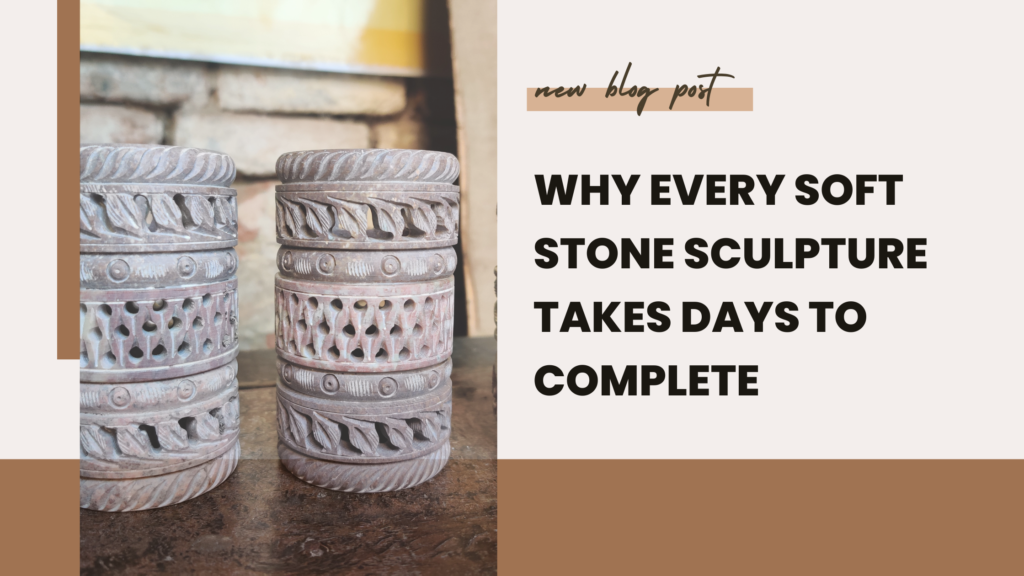
Why Every Soft Stone Sculpture Takes Days to Complete

Behind every finished piece is a process the world never sees — and a patience the world rarely understands. The Silence Before the First Strike There is a moment, before the chisel touches stone, when an artisan in Varanasi simply sits still. He does not reach for his tools. He does not sketch a design. He holds the raw piece of gorara — soft soapstone sourced from the mines of Chunar — and he studies it. He feels its weight, reads its grain, notices where the light falls differently on its surface. Only when the stone has told him what it wants to become does he finally pick up his chisel. This is not a ritual. This is the craft itself beginning. And this is precisely why a Kashi soft stone sculpture takes days — sometimes weeks — to complete. Not because the material is difficult. But because making something truly alive from stone demands a kind of attention that cannot be rushed. Step 1 — Choosing the Right Stone (Day 1) Soft stone is a metamorphic rock, also known scientifically as pyrophyllite. While marble is the hardest form of limestone, soapstone is the softest — and for this specific property, any kind of carving can be done by hand on it. But not every soft stone makes a great sculpture. In fact, the selection process alone can take hours. Artisans prefer a clean, evenly shaded stone — because if an artisan carves a detailed face on a multi-colored stone, the veins will appear crisscross or dotted, ruining the actual feel of the finished piece. D’source Furthermore, no two pieces of soft stone are ever alike — it is virtually impossible to get two carved pieces of identical color or design. Each block, therefore, demands individual study. The artisan must understand this particular stone — its character, its grain, its quiet personality — before a single cut is made. This is why the first day of creating a soft stone sculpture is often spent doing almost nothing visible. Watching. Thinking. Waiting for the stone to speak. Step 2 — Roughing Out the Form (Day 1–2) Once the right stone is selected, the real work begins — though it looks, at this stage, more like controlled destruction than creation. The making process starts by selecting fine quality stone. The big blocks are first roughly cut into shape according to the planned idol to be carved. The proportions are marked on the stone using charcoal and then the extra portion is taken out by hammering with hammer and chisel. Handicrafts Some artists use the stone itself as inspiration — the Renaissance artist Michelangelo claimed that his job was to free the human form trapped inside the block. D’source Kashi’s artisans, similarly, do not impose a design on the stone. They remove everything that is not the sculpture. This roughing-out stage is physically demanding and mentally exhausting. Every strike removes material that can never be put back. A miscalculation here does not mean a small mistake — it means starting over entirely. Consequently, even this early stage demands total focus, steady hands, and years of trained instinct. Step 3 — Secondary Shaping and Blocking In (Day 2–3) With the rough form established, the artisan moves into what craftsmen call the “blocking in” stage — refining the shape, establishing correct proportions, and beginning to suggest the details that will eventually define the piece. The roughed-out shape is further refined by gradually carving away larger sections of stone to establish the main proportions of the sculpture. As the sculpture takes shape, more intricate details are added using smaller tools like chisels, rasps, and files to create finer lines, textures, and contours. At this point in the process, the sculpture starts to reveal its character. A deity’s face begins to emerge. An elephant’s legs start to separate from the body. A jali panel’s geometric pattern begins to take its first visible form. Yet the artisan resists the urge to rush toward the details. He knows that strong foundations — correct proportions, balanced weight, clean primary forms — are what separate a masterpiece from a mediocre piece. This careful restraint, this refusal to hurry, is itself a skill that takes decades to develop. For a deeper look at different products made through this process, explore our complete soft stone idol collection. Step 4 — The Detail Work (Day 3–5) This is the stage that separates Kashi’s soft stone work from everything else in the world. Once rough details are carved, the detailing and ornamentations are carved using sharp-edged and pointed chisels. Handicrafts Here the real artistry lives — in the curve of an eyelid, the texture of a goddess’s hair, the delicate petals surrounding a deity’s feet, the mathematical precision of a jali lattice that must repeat perfectly across an entire panel. For complex pieces like the famous undercut elephant — where multiple figures sit nested inside each other with no joints or glue — this stage requires an almost meditative level of concentration. The undercut carving is very much known in the north part of India, and Varanasi is one of the main centers. A skilled artist can complete an undercut elephant of size two into three inches in just two hours D’source — but only after years of practice. A beginner attempting the same piece would need days, if they could complete it at all. For jali work specifically, the intricate work of jali making remains the skill of the masters — delicately chiseled and decorated with inlay work, these elaborately carved jalis demand time in their making along with the skill and creativity of the masters. oriGIn Browse our soft stone jali work collection to see what this dedication produces. Step 5 — Water, Patience, and the Long Middle Hours There is a sound in Kashi’s workshops that visitors always notice but rarely understand — the sound of water. Throughout the carving process, artisans sprinkle water repeatedly on the stone and on their

Blog

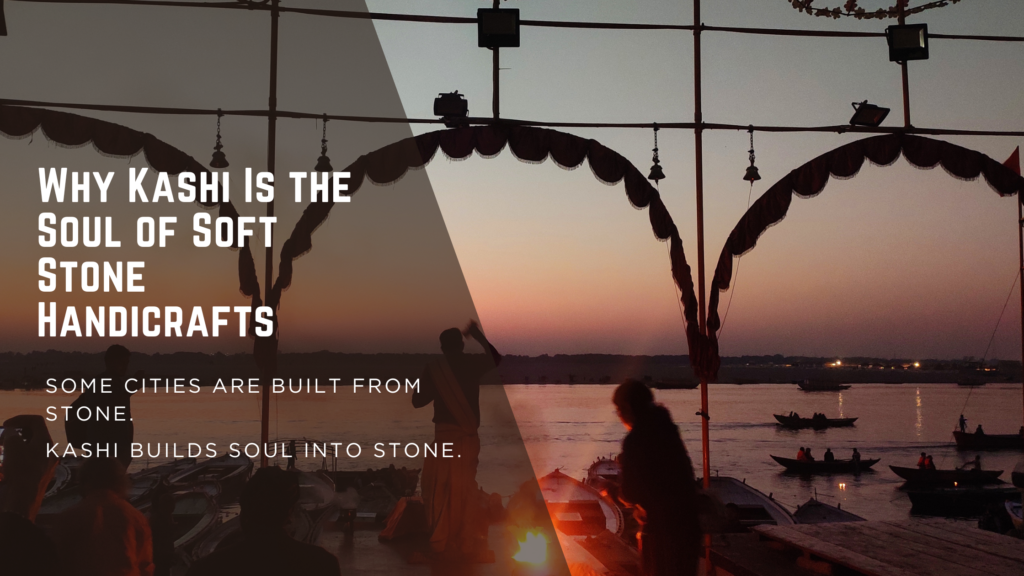
Why Kashi Is the Soul of Soft Stone Handicrafts

Some cities are built from stone. Kashi builds soul into stone. Where Stone Learns to Breathe There is a city in India that is older than history itself. Mark Twain once wrote that Varanasi is older than tradition, older than legend — and looks twice as old as all of them put together. But what most visitors miss, walking past the ghats and the temple bells and the incense smoke, is what is happening in the quiet lanes just behind all that divinity. In neighborhoods like Ramnagar, Luxa, and Vishwakarma Nagar, men sit cross-legged on stone floors. In their hands: a simple chisel. A small hammer. And a piece of soft, pale stone called gorara — soapstone — pulled from the earth of nearby Chunar. They tap. They pause. They study. They tap again. What emerges from those hands is not just a product. It is a conversation between a human being and the earth itself. This is Kashi soft stone handicraft — and no place on earth does it like Kashi does. The Stone That Chose Kashi Every great craft needs the right raw material, and Kashi was blessed by geography in ways that feel almost intentional. The Chunar and Mirzapur regions, just a short distance from Varanasi, hold some of India’s finest deposits of soft soapstone — locally called sajjar pathar or gorara. Artisans prefer clean, evenly shaded stones for carving, ensuring that variations in pigmentation or veining do not disturb the quality of their work. Antima Khanna The stone is pale, cool, almost luminous — a blank canvas that holds whatever the artisan imagines. What makes this stone extraordinary: It is soft enough to be shaped with hand tools, yet strong enough to last centuries. It carries a natural coolness to the touch that no synthetic material can replicate. It is lightweight, making it ideal for both local display and international shipping. And in its raw form, it has a quiet, humble beauty — as if it is already waiting to become something sacred. Artists originally carved on tusks and sandalwood, but as government regulations brought restrictions, they turned to the soapstone mines nearby — and the results were so successful that soapstone became the medium of choice. Antima Khanna What began as a necessity became a legacy. Five Centuries of Tap, Tap, Tap Close your eyes and imagine the sound of Kashi’s lanes in the 16th century. The Ganga flowing. Temple bells ringing. And underneath it all — the soft, rhythmic tapping of chisel on stone. Varanasi has long been the seat of Aryan religion and philosophy, a center of arts, crafts, music, and dance — famous for its muslin, silk, ivory works, and sculpture. oriGIn Soft stone carving was never separate from this identity. It grew from it. In early times, the artisans of Ramnagar received royal patronage from the royalties of Kashi themselves Authindia — the Maharajas who built the magnificent Ramnagar Fort understood that a city’s greatness is measured not just in its architecture, but in the hands of its craftspeople. The Varanasi soft stone jali work can be seen on forts, zamindari homes, places of worship, and ancient monuments — all of which stand as testimony to its antiquity. IBEF Five centuries later, the tapping continues. The craft did not die. It adapted, evolved, and endured — because in Kashi, nothing truly ends. The Art That Defies Logic — The Undercut Miracle If you want to understand why the world is fascinated by Kashi’s soft stone work, look at one product: the undercut elephant. Inside a single, unbroken piece of soapstone, an artisan carves a full elephant — and inside that elephant, another smaller elephant — and inside that, another. Multiple figures, nested within each other, with no glue, no joints, no separate pieces. Creating multiple shapes one inside another by carving stones — without any joints — is a unique craft of the Kashi artisans. Google Translate It is the kind of thing that, when you hold it in your hand, makes you question what is possible with patience and skill. A skilled artist can complete an undercut elephant measuring two to three inches in just two hours. Antima Khanna Two hours for something that looks like it should take a lifetime to understand, let alone create. This is the signature of Kashi — not just beauty, but impossible beauty. The Jali — Where Stone Becomes Lace If the undercut elephant is Kashi’s miracle of depth, the jali (lattice fretwork) is its miracle of lightness. Imagine stone that looks like lace. Panels so delicately pierced and patterned that light passes through them like it passes through a silk curtain. Geometric patterns so precise they seem mathematical. Floral motifs so fine they seem drawn, not carved. Jali or fretwork is intricately carved on soft stone, and its process requires supreme mastery of masonry and design making — epitomizing both high skill and superior quality of craftsmanship. District Varanasi This is not decoration. This is devotion made physical. Every jali panel represents hundreds of calculated chisel strikes, each one placed with the confidence that comes only from a lifetime of practice. One wrong strike — and the piece is lost. There is no undo button in stone. The Artisans — Men Who Speak in Stone Behind every breathtaking piece is a man whose name the world will never know. He woke up before sunrise. He sat in the same corner of the same small workshop where his father sat, and his grandfather before that. His tools are simple — a chisel, a hammer, sandpaper, and water sprinkled occasionally to keep the stone cool. The craftsman first studies the natural design contained in the stone itself, then shapes it carefully with chisel and hammers, sprinkling water repeatedly to avoid heat generation. oriGIn He does not sketch elaborate blueprints. The design lives in his hands, inherited through muscle memory across generations. Today, around 500 to 700 artisans are engaged in this traditional craft Google

Shopping Cart
Scroll to Top