
Two stones. Two traditions. Two completely different conversations with the divine.
The Question Every Buyer Eventually Asks
You are standing in front of two beautiful idols. Both are stone. Both are hand-carved. Both carry the same deity, the same posture, the same devotion in the hands that made them.
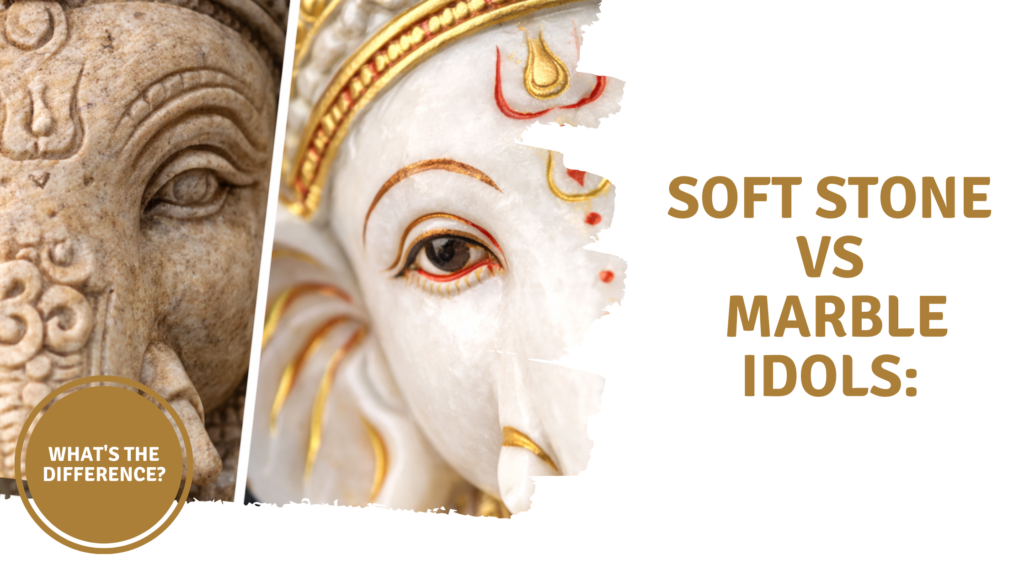
One is marble. One is Kashi soft stone — gorara.
They look similar at a glance. But the moment you pick them up, something shifts. The weight is different. The texture is different. The feeling in your hand is different. And if you know what you are looking for, the story behind each one is completely different too.
This guide exists to help you understand that difference — not just technically, but in every way that matters when you are choosing an idol for your home, your pooja space, or as a gift to someone you love. And by the end, you will know exactly which one belongs in your life. Browse our complete soft stone idol collection to see Kashi’s craft up close.
First — What Are These Two Stones, Actually?
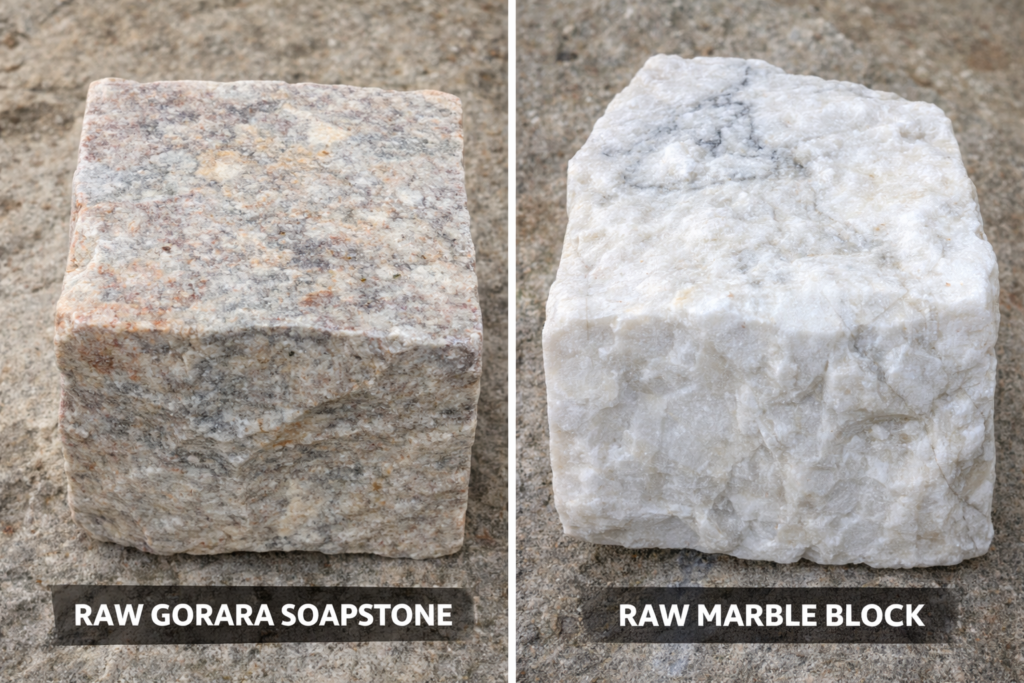
Before comparing the idols, it helps to understand the materials themselves.
Soft stone — called gorara or sajjar pathar in Varanasi — is a metamorphic rock whose scientific name is pyrophyllite. Soapstone, or steatite, is soft enough to carve with a knife. It is composed of talc and has a slippery, soapy feel. District Varanasi On the Mohs hardness scale — where diamond sits at 10 — soapstone typically ranges from 1 to 5, while marble ranges from 3 to 5. oriGIn Furthermore, artistic soapstone, which is what sculptors use, can have talc content as high as 80%, making it about as silky and soft as real soap — which makes it very easy to carve. Google Translate
Marble, on the other hand, is limestone that underwent extreme heat and pressure inside the earth. Polished marble is smooth and silky with a highly reflective surface — you can often see your face reflected in it. Marble is at least two colors or tones and has a distinct pattern. D’source Although marble is durable, it is also soft enough to carve detailed designs — this balance makes it perfect for creating intricate idols and sculptures. Antima Khanna
In other words, both are beautiful. Both are carvable. But they come from different geological journeys — and they produce very different results in an artisan’s hands.
For a deeper understanding of soft stone specifically, read our complete guide: What Is Soft Stone? Why Is It Used in Varanasi Handicrafts?
Difference 1 — Hardness and Carving Detail
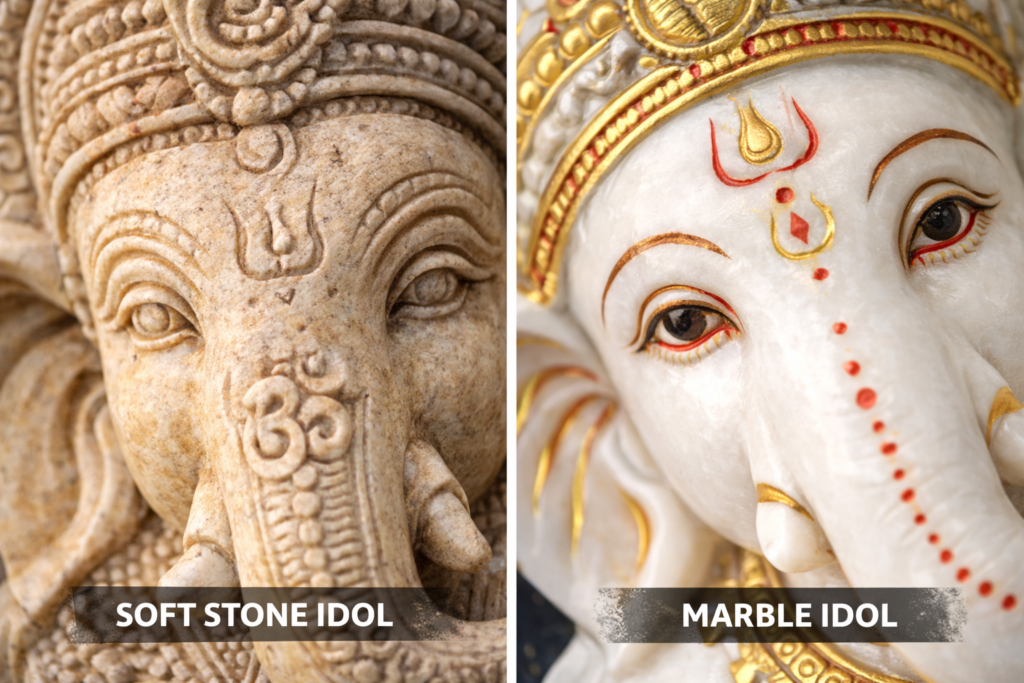
This is where the two materials diverge most dramatically — and where Kashi’s soft stone tradition earns its reputation.
Soapstone allows for intricate carvings and ages beautifully over time, while marble is favored for its smooth texture and elegance, making it ideal for refined, freestanding idols. D’source
Because gorara is so much softer, Varanasi artisans can cut inward, around corners, and behind surfaces in ways that marble simply does not allow. This is why the undercut technique — where multiple figures sit nested inside each other from a single unbroken piece of stone — exists only in Kashi’s soft stone tradition. Attempting it in marble would shatter the piece.
Marble, conversely, holds its surface detail with greater permanence. A sharp line carved into marble stays sharp for decades. Marble consequently works beautifully for large, bold idol forms where presence and polish matter more than intricate interior carving.
The honest comparison: soft stone wins on fineness of surface detail and depth of carved work. Marble wins on bold, high-polish visual impact from a distance.
Difference 2 — Weight and Practical Use
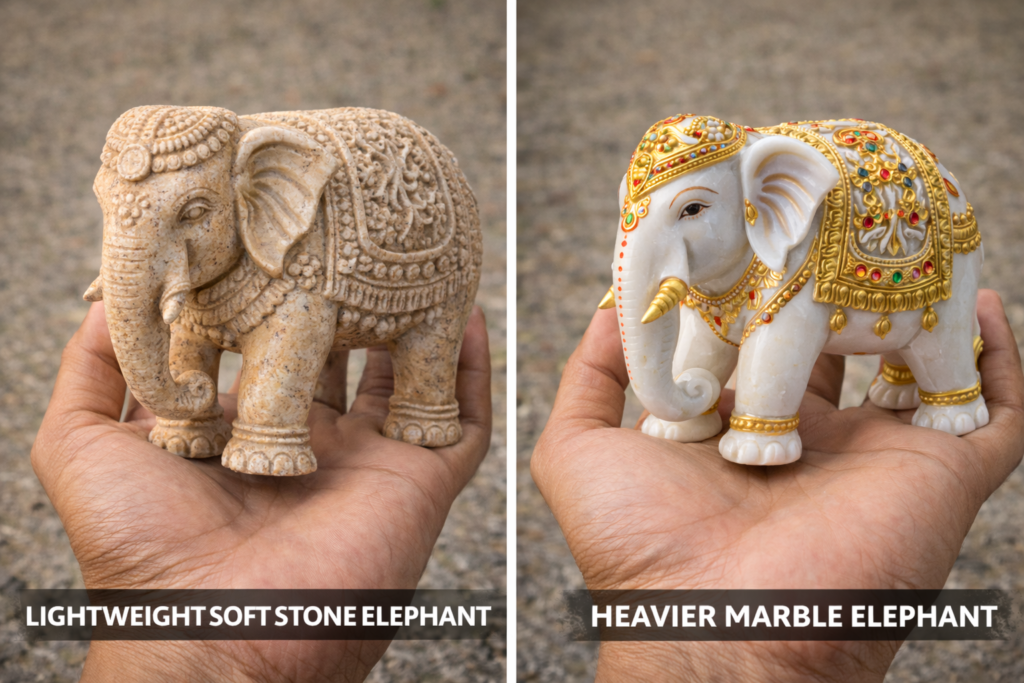
Pick up a soft stone idol. Then pick up a marble idol of the same size.
The difference is immediate and surprising.
When held to the light, soapstone has a smooth, greasy, silky, milky luster. If thin, it is translucent. It is cold to the touch. D’source But beyond feel, it is meaningfully lighter. This weight difference matters in several practical ways.
For pooja and daily use, a lighter idol is easier to move, clean, and arrange. For gifting, soft stone pieces can be shipped internationally at far lower freight costs — which is one reason Kashi’s handicrafts reach Paris, Dubai, and New York from a workshop in Ramnagar. For home display, lighter pieces work on shelves, mantelpieces, and altars without structural concern.
Marble idols, meanwhile, carry a sense of permanence and weight that many devotees specifically seek. A large marble murti in a home temple feels anchored — like it belongs there and will never move. Makrana marble is so durable that it lasts for generations without losing its shine, is easy to clean, and looks beautiful in any home or temple. Antima Khanna
The honest comparison: soft stone for lightweight versatility and travel. Marble for large, permanent, temple-grade presence.
Difference 3 — Color, Texture, and Uniqueness
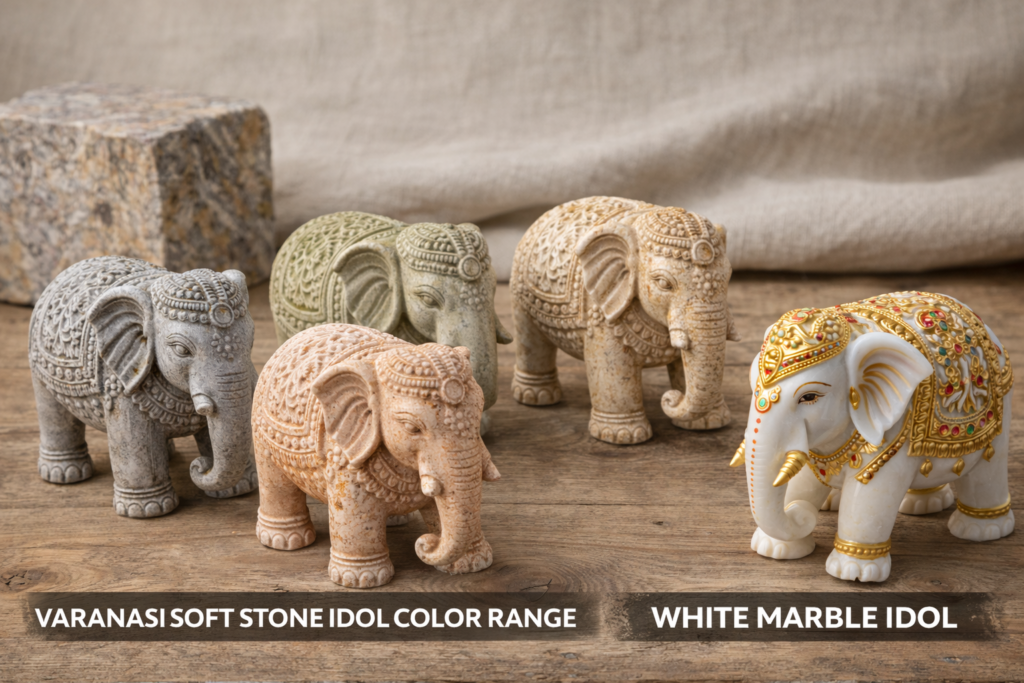
This difference is perhaps the most poetic — and the most important for buyers who value authenticity.
Marble is celebrated for its classic look. Makrana white marble — the same stone used in the Taj Mahal — is famous for its luminous, pure white surface and elegant veining. It is consistent, predictable, and unmistakably grand.
Soft stone is the opposite of predictable. The talc in soapstone gives it unique milky, muted colors that add a vintage or rustic look. The most common colors of soapstone range between white and gray — some slabs will darken or develop slight greenish tones over time. oriGIn Varanasi’s gorara, furthermore, extends this range dramatically — from creamy white and pale gray to bright pink, deep green, and even black, depending on the specific block.
Moreover, no two pieces of gorara are ever alike — not even from the same block. Every genuine Kashi soft stone idol is therefore completely unique in the world. It is mathematically impossible for your piece to be identical to anyone else’s.
Marble, by contrast, can be reproduced with relative consistency — which is why machine-made marble idols flood the market. Mass-produced cultured marble, marble dust, and resin idols lack spiritual authenticity, durability, and long-term legacy value compared to idols hand-carved from natural stone. Directcreate
The honest comparison: marble for classic, consistent elegance. Soft stone for one-of-a-kind, living color and natural character.
Difference 4 — Porosity and Maintenance
This is a practical difference that most buyers never consider — until it matters.
The main difference between marble and soapstone? Marble is porous, while soapstone is non-porous. D’source
What does this mean for an idol in daily use? A marble idol, being porous, can absorb oil, incense ash, turmeric, kumkum, and other pooja materials over time. Without periodic resealing, these stains can become permanent. Marble requires frequent sealing to prevent stains and etching. Handicrafts
Soft stone, on the other hand, naturally resists staining because nothing penetrates its surface. Soapstone is naturally stain-proof, even against acid and bleach. It can be wiped clean with a damp cloth. Additionally, if soapstone develops imperfections over time, you can simply buff them out with sandpaper and finish by rubbing on oil to make it look new again. Handicrafts Marble, by contrast, requires professional repair for significant damage.
The honest comparison: soft stone requires less maintenance and handles daily pooja use more forgivingly. Marble requires more care but, with that care, maintains its polish and grandeur for generations.
Difference 5 — Spiritual and Cultural Significance
Both materials carry deep spiritual meaning in Indian tradition. However, they carry it differently.
Marble idols — particularly those made from Makrana white marble — are closely associated with the grand temple tradition. Marble provides natural shine, gives statues a natural glow, and keeps every detail sharp — its durability ensures that the art stays beautiful for years. Antima Khanna Large marble murtis grace temples from Varanasi to Vrindavan to Tirupati. They project power, purity, and permanence.
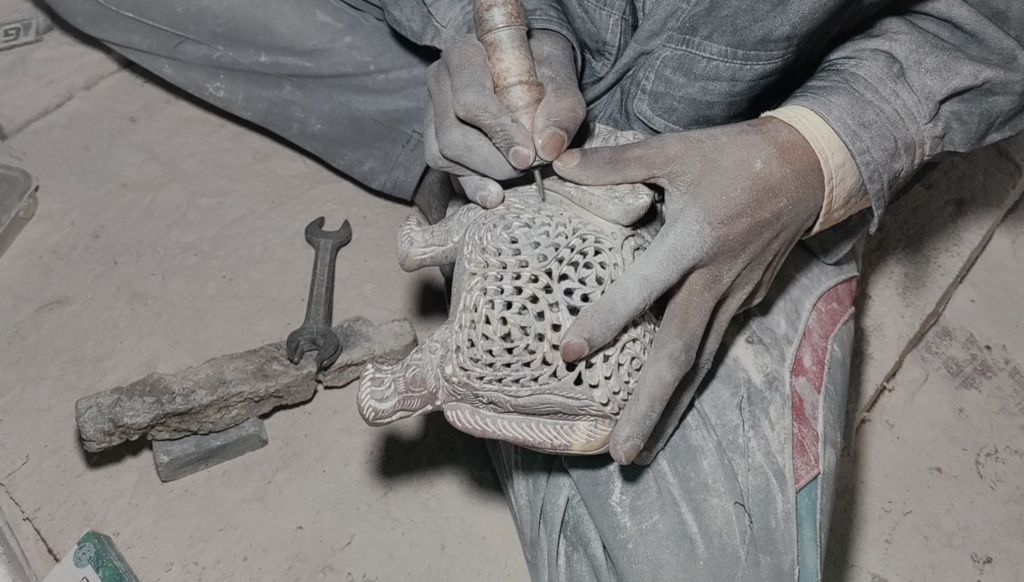
Soft stone idols from Varanasi carry a different energy. They are quieter. More intimate. The natural color variation of gorara gives each piece an organic warmth that pure white marble does not always possess. Furthermore, because every piece is genuinely unique, a soft stone idol carries the specific energy of its making — the specific block, the specific artisan, the specific days spent in a Ramnagar workshop.
Soapstone is favored in Karnataka and Tamil Nadu for fine detailing — it darkens with age, acquiring a rich, antique finish. D’source Varanasi’s gorara similarly develops character with time. An idol you bring home today will look subtly different — and more beautiful — in five years. It ages the way something living ages.
The honest comparison: marble for grand, temple-grade spiritual presence. Soft stone for intimate, personal, evolving connection with the divine. Explore our full range of Varanasi soft stone deity idols and experience that difference yourself.
Difference 6 — Techniques Only Possible in Each Material
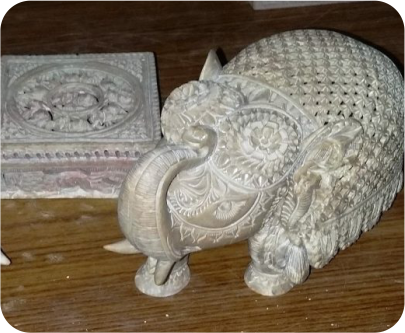
Certain things can only be done in certain materials. This is perhaps the clearest way to understand why both traditions exist — and why both matter.
In soft stone only: The undercut carving technique — multiple nested figures from one unbroken block — is physically possible only because gorara yields to the chisel at every angle without shattering. Jali fretwork so delicate that light passes through it like silk is also uniquely a soft stone achievement. Read our full guide: Why Every Soft Stone Sculpture Takes Days to Complete.
In marble only: Large-scale temple murtis — 3, 4, 5 feet tall — that need to support their own weight outdoors or in high-footfall temple environments are almost always marble or granite. Marble is softer than granite, making it easier to carve and shape — but it holds very fine detail and, when brought to a high polish, its crystalline structure sparkles. That sparkle at scale, in monumental idol work, is irreplaceable.
The honest comparison: soft stone for intimate, impossibly detailed small-to-medium work. Marble for large, high-polish, monumental presence.
The Quick Comparison Table
| Feature | Soft Stone (Gorara) | Marble |
|---|---|---|
| Hardness (Mohs) | 1–2 | 3–5 |
| Weight | Light | Heavy |
| Color Range | Gray, pink, green, cream, black | Usually white/off-white with veining |
| Every Piece Unique? | Yes — always | Not always |
| Porosity | Non-porous — stain resistant | Porous — needs sealing |
| Maintenance | Low — wipe clean | Medium — periodic sealing |
| Best For | Fine detail, undercut, jali, gifting | Large idols, temples, outdoor |
| Ages Over Time | Develops warm patina | Maintains original polish with care |
| GI Protected? | Yes — Varanasi Soft Stone | No GI tag |
| Unique Technique | Undercut carving, jali fretwork | High-polish monumental carving |
So — Which One Should You Choose?
The honest answer is that this is not a competition. Both materials are extraordinary. Both traditions are ancient. Both deserve respect.
Choose soft stone if you want something intimate, unique, and alive with natural color — an idol that no one else in the world has an exact copy of, made by artisan hands in Ramnagar using a 500-year-old tradition protected by a GI Tag.
Choose marble if you want grandeur, permanence, and the classic luminous white that has graced India’s greatest temples and monuments for centuries.
Choose both if you understand, as many collectors do, that a pooja space benefits from the warmth of gorara alongside the brilliance of marble. They are not competitors. They are companions.
Whatever you choose, choose something genuinely handmade. Mass-produced cultured marble, marble dust, and resin idols sold online lack spiritual authenticity, durability, and long-term legacy value — unlike idols hand-carved from natural stone. Directcreate Before purchasing, always read our complete guide to identifying authentic Varanasi handicrafts.
FAQ — Soft Stone vs Marble Idols
Q1. Is soft stone or marble better for a home pooja idol?
Both work beautifully for home pooja. Soft stone is better for daily use because it is non-porous, stain-resistant, lightweight, and easy to clean. Marble offers more grandeur and permanence but requires periodic sealing and more careful maintenance. If your pooja involves daily application of oil, turmeric, or kumkum, soft stone is the more practical choice.
Q2. Which idol lasts longer — soft stone or marble?
Marble is harder and therefore more scratch-resistant over time. However, soft stone is non-porous, which means it does not absorb stains or moisture that can degrade marble if left unsealed. Both last for generations with proper care. Soft stone can also be repaired at home with simple sanding, while marble damage requires professional restoration.
Q3. Why is Varanasi specifically famous for soft stone idols and not marble?
Varanasi’s proximity to the Chunar and Mirzapur soapstone mines, combined with 500 years of artisan tradition, made gorara the natural medium of Kashi’s craft. The softness of gorara enables techniques — like undercut carving and jali fretwork — that are physically impossible in marble. Varanasi Soft Stone Jali Work also holds an official GI Tag, recognizing it as a protected and uniquely local craft.
Q4. Can I tell the difference between soft stone and marble just by looking?
Yes, with some practice. Soft stone has a matte, slightly milky surface with natural color variation across the piece — grays, pinks, greens, or creams. Marble typically has a shinier, more reflective surface and a distinct veining pattern. Soft stone is also noticeably lighter than marble of the same size. When in doubt, ask the seller for the material and GI certification.
Q5. Are all white-colored idols marble?
No. Many white or off-white idols are made from soft stone, alabaster, or even synthetic marble dust. Genuine marble feels heavier and has characteristic veining. Soft stone feels lighter, cooler, and has a more matte surface. Always ask the seller to confirm the material — and be cautious of very low prices, which often indicate synthetic or machine-made pieces.
Q6. Is a soft stone idol suitable for outdoor placement?
Generally, no. Soft stone is best for indoor display and home pooja spaces. Its softness makes it vulnerable to weathering, rain, and temperature changes outdoors. Marble and granite are far better choices for garden or outdoor temple placements. For outdoor idols, we recommend consulting our guide on choosing the right stone idol for your space.
Q7. Which is more affordable — soft stone or marble idols?
For comparable sizes and quality, soft stone idols from Varanasi are generally more affordable than high-quality marble idols — particularly Makrana marble pieces. However, price varies significantly based on size, detail complexity, and craftsmanship. A highly detailed soft stone undercut piece can cost more than a simple marble idol. Always prioritize craftsmanship and authenticity over price alone.