Before an artisan picks up his chisel, the stone has already lived a million years. Understanding what it is makes you understand why it matters.
A Stone Unlike Any Other

Most people who hold a piece of Varanasi soft stone for the first time say the same thing: it feels warm. Not temperature-warm — emotionally warm. There is something about its surface, its weight, its quiet luminosity that feels less like holding a rock and more like holding something that was once alive.
That feeling is not a coincidence. It comes directly from what soft stone actually is — and from the extraordinary journey it took, across millions of years and thousands of miles beneath the earth, to arrive in an artisan’s hands in the lanes of Ramnagar, Varanasi.
This is the story of soft stone — the heart of Varanasi’s most celebrated handicraft tradition.
What Is Soft Stone, Scientifically?
Soft stone — known locally in Varanasi as gorara or sajjar pathar — is a metamorphic rock whose scientific name is pyrophyllite. It belongs to the same broad mineral family as talc, which is why it registers at the very bottom of the Mohs hardness scale — between 1 and 2 — making it one of the softest natural stones on earth.
While marble is the hardest form of limestone, soapstone is the softest and is easy to work on. For this specific property, any kind of carving can be done by hand on soft stone. oriGIn
Artistic soapstone is made up of 80% talc. It is so soft that it can be scratched with a fingernail. D’source This extreme softness is not a weakness — it is precisely the quality that makes it the perfect canvas for the kind of impossibly detailed hand carving that Varanasi is famous for.
Soapstone is relatively soft because of its high proportion of talc. Softer grades may feel similar to soap when touched, hence the name. Soapstone is easy to carve — it is also durable and heat-resistant and has a high heat storage capacity. D’source
For a deeper understanding of how this stone becomes finished art, read our detailed guide on the complete soft stone carving process in Varanasi.
Where Does Varanasi’s Soft Stone Come From?
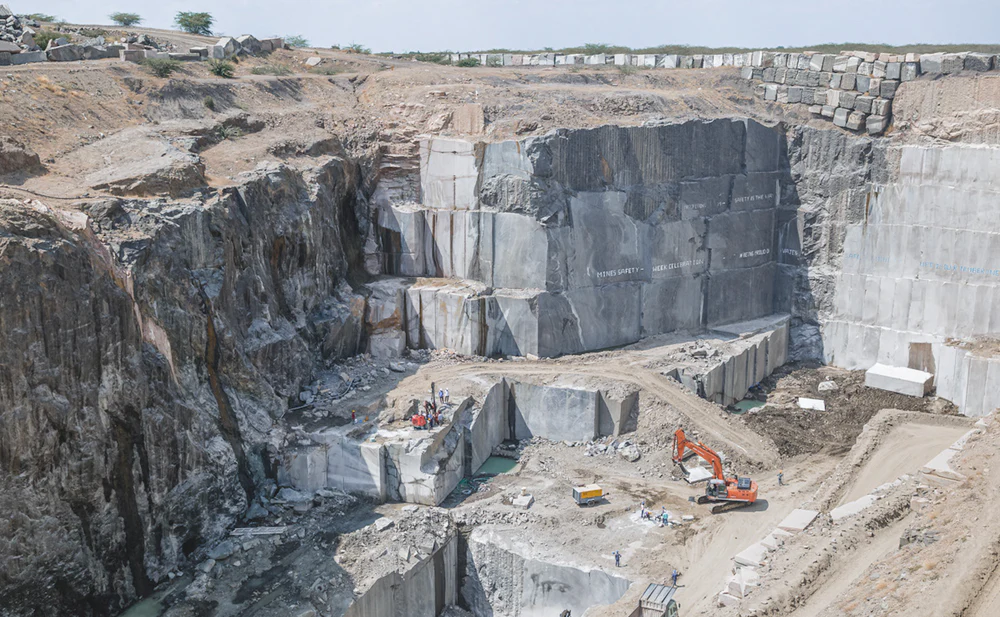
Geography gave Varanasi a gift that no other city in India quite received.
Stones are brought from mines of Chunar and Shivpuri in Madhya Pradesh. The most appreciated quality of this stone is that it is available in a wide range of colors and is easy to carve. KRAFTERIA
The stone work of Varanasi is very different from other places. Instead of hard marble, carving is done on a soft stone called gorara — a stone brought from the Hamirpur and Mahoba areas. The uniqueness of gorara is its unpredictable range of colors. On polishing, mottled gorara brings out a hue of shades varying from gray to bright pink, green to black. Handicrafts
Gorara stone is easy to carve, durable, and popular for its heat-resistant properties. One of the distinctive properties of gorara stone is its unpredictable color spectrum, which may vary from beautiful shades of gray to bright pink.
This color unpredictability is not a problem to be solved — it is the magic of the material. Every block that arrives in a Varanasi workshop is a surprise. Every finished piece is therefore, by definition, one of a kind.
The Most Important Fact About Soft Stone
Here is the fact about soft stone that separates it from every other carving material in the world — and the fact that every buyer should understand before purchasing:
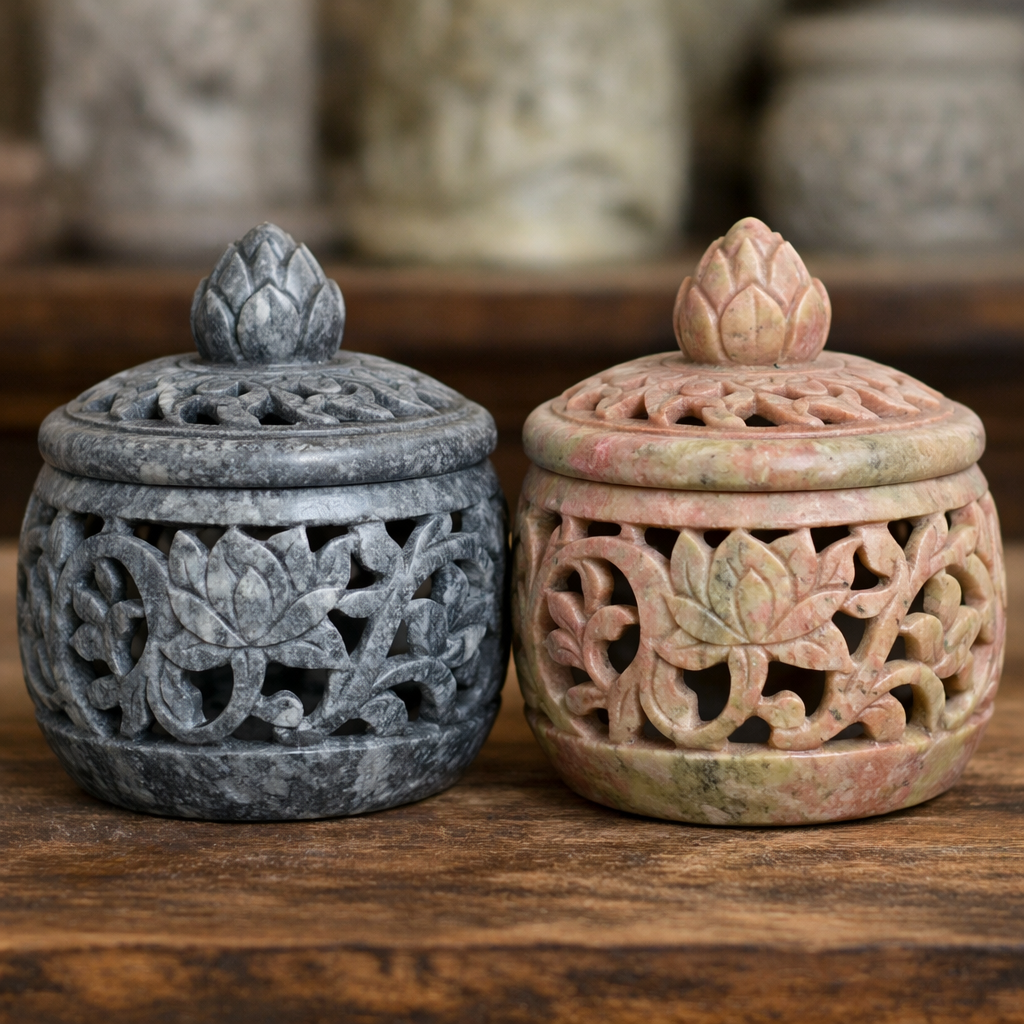
There is no homogeneity of colour, tint and texture in soft stone. Two pieces taken out even from the same block of soft stone are never alike. Thus, it is virtually impossible to get two carved pieces of soft stone of identical colour or design. You may say soft stone is blessed by nature. They are like free hand sketches by a small child. oriGIn
Read that again: no two pieces are ever alike. Not from different blocks, not even from the same block. Every single piece of genuine Kashi soft stone is therefore, mathematically and naturally, unique in the entire universe.
This is why machine production cannot replicate what Varanasi artisans do. A machine can be programmed for one stone — but the next stone will be different. And the one after that. The hand of the artisan is the only instrument sensitive enough to respond to each stone individually, in real time, with each chisel strike.
Why Soft Stone — Not Marble, Not Granite?
This is the question at the heart of Varanasi’s craft identity. India has marble. It has granite. It has sandstone. So why did Varanasi’s artisans choose soft stone — and why do they continue to choose it today?
The answer has several layers. Starting with history — in the early stages of stone carving, artists used tusks and sandalwood as their primary medium. However, due to government regulations and constraints, they had to seek alternatives. The nearby soapstone mines became the experimental ground for these artists, where they replicated their designs previously carved on tusks.
What began as necessity quickly became preference — and then mastery. Because soft stone, it turned out, could do things that no other material could. Consider what makes it uniquely suited to Varanasi’s craft tradition specifically:
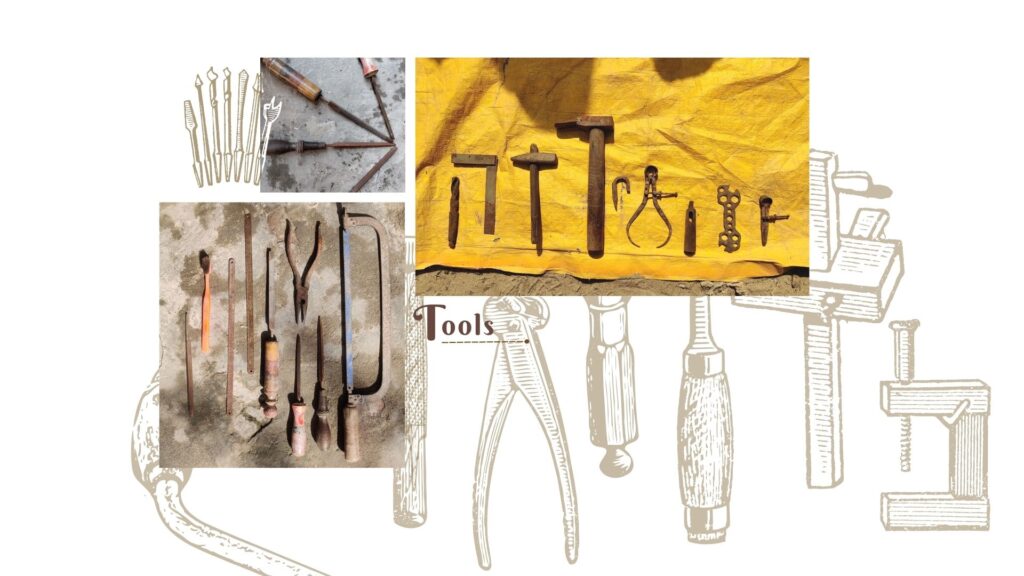
It responds to simple hand tools. The undercut carving technique — where figures sit nested inside each other with no joints — is physically impossible in marble. The material is too hard, too unforgiving. In gorara, a skilled artisan can carve inward, around, and behind without the piece shattering. Furthermore, it is lightweight. This matters enormously for both the artisan — who works with it for hours daily — and for the buyer, who can ship it internationally without freight costs making it unaffordable. Additionally, it accepts color beautifully. Because the surface is so smooth and fine-grained after polishing, painted details, inlay work, and natural dyes all sit on gorara with a richness that harder stones cannot match. And above all, every piece is genuinely unique. In a world of mass production, this is not a small thing. It is everything. Explore our full collection of handmade soft stone idols — each one carrying its own unrepeatable character.
What Products Does Soft Stone Make?
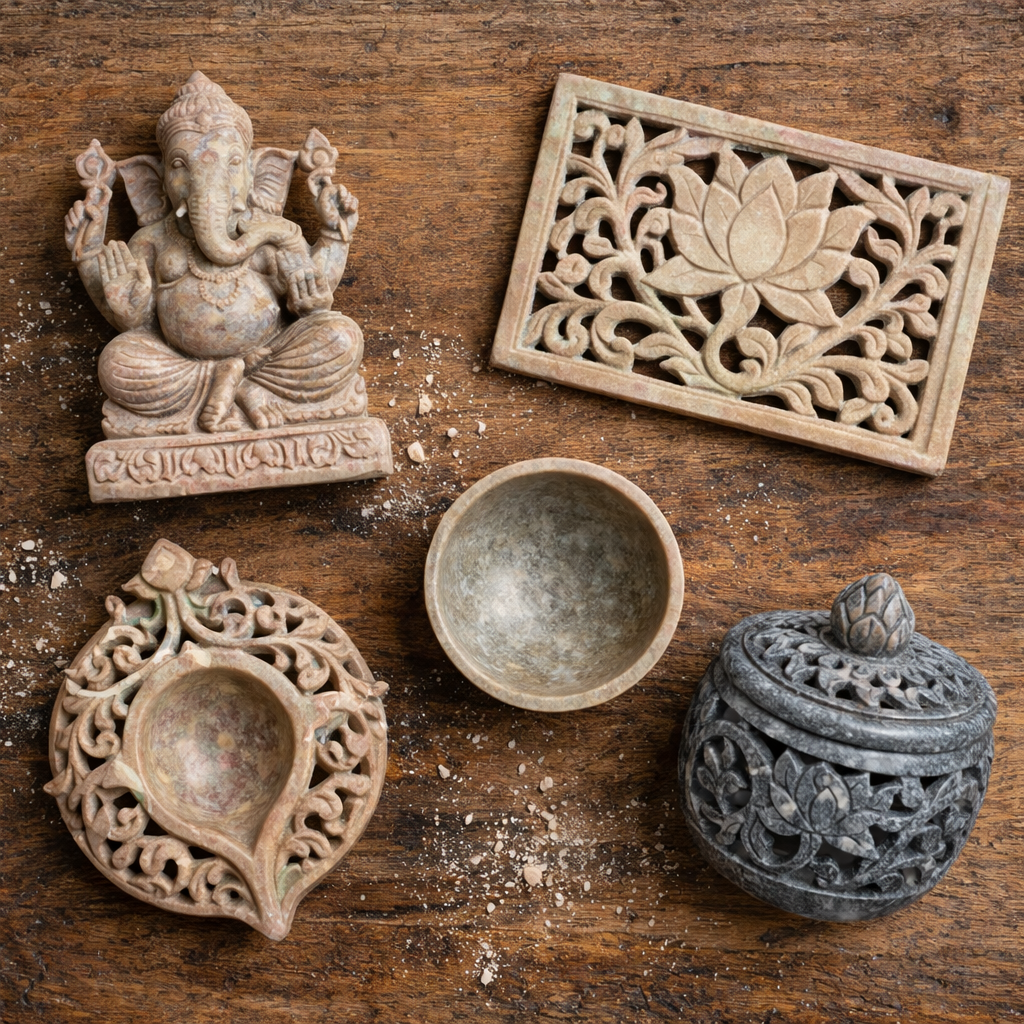
The artwork on stone is a combination of carving, inlaying, engraving, sculpture, and undercut — the art of making multi-layered decorative items out of one single piece of stone, hollowed from inside. Handicrafts
The range of what gorara produces in Varanasi’s workshops is broader than most people realize:
Deity idols and figurines — Ganesh, Lakshmi, Saraswati, Buddha — carved in extraordinary detail, sometimes with painted faces and inlaid semi-precious stone jewelry. Jali panels — delicate lattice screens so finely pierced that light passes through them like sunlight through silk. These are among the most technically demanding pieces in the craft. Browse our jali work collection here. Diyas and urli bowls — functional and beautiful, the natural heat resistance of soapstone makes these ideal for actual use with oil and flame. Explore our stone diya collection. Decorative boxes and trays — often featuring painted motifs or inlay work. Undercut sculptures — the signature miracle of Kashi, where multiple figures sit carved inside each other from a single unbroken block.
The fragile jali work in these artifacts is inspired by the decorations from the palaces of Rajasthan.
How Soft Stone Becomes Art — A Brief Overview
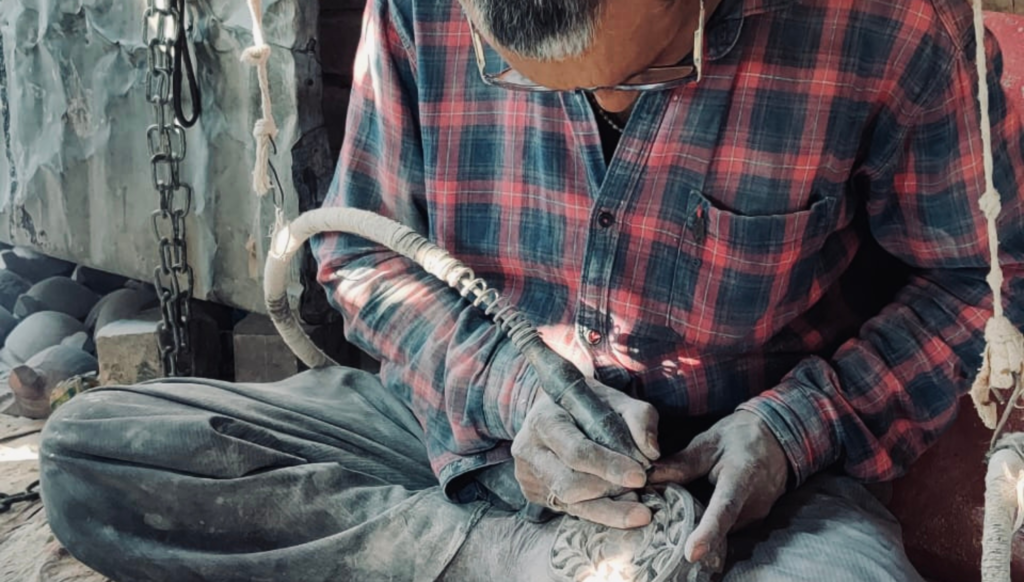
The journey from raw block to finished sculpture follows a process that has remained largely unchanged for centuries. The artisan begins by selecting the right stone — studying its color, grain, and character before making a single mark. He then rough-cuts the basic form, removes excess material, and gradually refines the shape through increasingly detailed tool work. Water is sprinkled constantly throughout — it keeps the stone cool, the tools sharp, and the artisan’s view of the surface clear.
The finishing stage — sanding, polishing with a local stone called batti, and sometimes inlaying with semi-precious stones or shell — can add another full day to the process. Soapstone exposed to high levels of metamorphism has a fine grain size and is used for highly detailed carvings. D’source The finest gorara, once polished, takes on a surface that feels almost warm — smooth, cool, and faintly luminous.
For the complete step-by-step breakdown, read our full guide: Why Every Soft Stone Sculpture Takes Days to Complete.
Soft Stone and the GI Tag — Why Origin Matters
The quality of Varanasi’s soft stone craft is so distinct — and so tied to this specific geography, material, and community — that it earned a Geographical Indication Tag on 28th March 2018. This certification places it alongside Darjeeling tea and Banarasi silk as a protected craft that can only come from one place.
The GI tag matters because gorara from Chunar, worked by Varanasi hands, is genuinely different from imitations made elsewhere. The stone is different. The technique is different. The result is different. Knowing what soft stone is — and where it comes from — is therefore the first step in knowing whether what you are holding is the real thing. For everything you need to know about spotting authentic pieces, read our complete authenticity guide.
Stone That Carries Time
Millions of years ago, with far-reaching metabolic changes taking place, every kind of organic and inorganic matter on the surface of the earth kept caving in and remained there under tremendous pressure and temperature oriGIn — and gorara was born from that process. It took the earth a million years to make the material. It takes a Varanasi artisan days to reveal what was always inside it.
When you hold a piece of Kashi soft stone, you are therefore not just holding a handicraft. You are holding geology and human skill meeting across millions of years. You are holding the Chunar mines and the Ramnagar workshops and the patient hands of a craftsman who learned from his father, who learned from his.
Soft stone is not just a material. In Varanasi, it is a language. And these artisans are among the last fluent speakers. Browse our complete Varanasi soft stone collection — and bring a piece of that language home.
FAQ — What Is Soft Stone?
Q1. What exactly is soft stone or gorara used in Varanasi handicrafts?
Gorara is the local Varanasi name for soapstone — a metamorphic rock scientifically called pyrophyllite. It is one of the softest natural stones on earth, ranking between 1 and 2 on the Mohs hardness scale. Stones are sourced primarily from mines in Chunar, Mirzapur, Hamirpur, and the Shivpuri region of Madhya Pradesh.
Q2. Why is soapstone preferred over marble for Varanasi carvings?
Soapstone is far softer than marble, which means artisans can carve it entirely by hand with simple tools. This allows techniques — like undercut carving and delicate jali fretwork — that are physically impossible in harder stones. Its light weight also makes it practical for both artisans working daily and buyers shipping pieces internationally.
Q3. Is every piece of Varanasi soft stone truly unique?
Yes — completely and scientifically. There is no homogeneity of color, tint, or texture in soft stone. Two pieces taken from even the same block are never identical. It is therefore impossible to produce two carved pieces of identical color or design — making every genuine piece one of a kind by nature.
Q4. What colors does gorara soapstone come in?
Gorara’s color range is naturally unpredictable — one of its most celebrated qualities. On polishing, it reveals shades ranging from creamy white and pale gray to bright pink, green, and even black. The exact colors that emerge depend entirely on the specific block, which is why each piece surprises even the artisan making it.
Q5. Is soft stone durable? Will it break easily?
Despite its softness during carving, finished and polished gorara is surprisingly durable for display and household use. Its natural heat resistance also makes it ideal for functional pieces like diyas and bowls. However, it should be handled with reasonable care — it is softer than marble and will chip if dropped on hard surfaces.
Q6. Can I tell a genuine soft stone piece from a fake?
Yes. Genuine gorara feels cool and slightly silky to the touch, is lighter than marble of similar size, and shows subtle natural color variation across its surface. Hand-carved pieces also carry slight organic irregularities in the lines. Always ask for GI Tag certification. Read our full guide on identifying authentic Varanasi handicrafts for a complete checklist.
Q7. What is the difference between gorara and palewa stone?
Both gorara and palewa are types of Indian soapstone — regional names for the same broad mineral family. Gorara is the term used specifically in Varanasi and is sourced from the Chunar-Mirzapur region. Palewa is more commonly associated with Rajasthan. Both are pyrophyllite-based soft stones, but their color ranges and carving properties differ based on their specific mineral composition and origin.